.avif)
Welcome Email Examples for Shopify: 8 That Convert (and How to Build Them in Klaviyo)

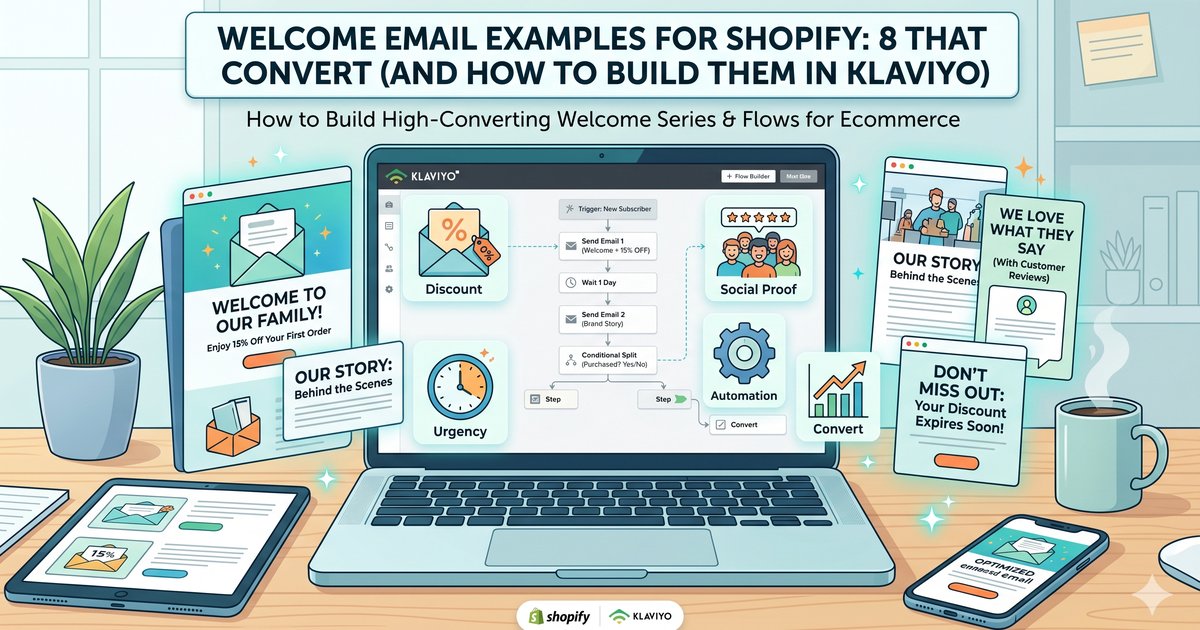
TL;DR: The best welcome email examples for Shopify share three traits: a value-driven subject line, an instant discount, and a short path to the first purchase. This guide breaks down 8 high-converting examples, what makes each one work, and how to build them as a Klaviyo welcome flow. You will learn which emails to send, when to send them, and what revenue to expect.
Your welcome email is the single most profitable automated message your Shopify store will ever send. Welcome emails earn an average open rate near 51% and a placed-order rate around 2%, while standard campaigns sit closer to 15 to 20% opens. Yet most stores either send one generic "thanks for subscribing" note or skip the welcome series entirely.
That is a costly miss. A new subscriber is never more interested than the moment they hand over their email. The strongest welcome email examples for Shopify use that window to introduce the brand, deliver a reason to buy, and move someone toward a first order while attention is high. Below are 8 examples worth copying, plus the exact Klaviyo setup behind each one.
What makes a good Shopify welcome email?
A good Shopify welcome email delivers the promised incentive instantly, states one clear next step, and reflects the brand in three seconds or less. It opens with a value-led subject line, keeps copy tight, and points to a single call to action. The goal is one decision: start shopping.
The brands that win keep the design simple. According to Shopify's guidance on welcome emails, a crisp layout with minimal text blocks and clear visual cues reduces cognitive load and gets readers to the button faster. You are not telling your whole story in email one. You are removing friction between "I just signed up" and "I just bought."
Hold every example below against three tests: the subject line earns the open, the offer is impossible to miss, and the path to purchase is obvious.
What are the best welcome email examples for Shopify?
The best welcome email examples for Shopify fall into a few proven formats: the instant-discount email, the warm personal greeting, the brand-story note, the social-proof email, and the urgency closer. Each one does a specific job inside a welcome series, and the highest-earning stores use several together rather than relying on one.
Here are four formats to copy for your first emails:
The instant-discount welcome (Drunk Elephant style). Skincare brand Drunk Elephant leads with "15% off" as both the headline and the subject line, followed by bold branded copy and a single shop button. No clutter, just the reward and the action. This works because the subscriber already raised their hand for a deal in the popup. Burying the code three paragraphs down adds friction for no reason.
The warm, personal welcome (Makeup Geek style). Makeup Geek greets the subscriber by name, includes a thank-you discount, and features three "fan favorite" products to nudge browsing. Even a soft welcome needs a job to do, and those featured products give an undecided shopper somewhere to click instead of a homepage where they have to figure out where to start.
The witty subject-line welcome (Yellowbird style). Hot sauce brand Yellowbird uses "Your inbox just got a little hotter" to tie the subject to the product while sparking curiosity. Pair personality with clarity, though. Klaviyo's research found "Welcome to ___" is the single highest-performing subject line pattern for opens, clicks, and revenue per recipient, so lead with clear value and add wit on top.
The urgency welcome (expiring discount). Nonna Live's "HURRY, claim your 15% off discount" pushes subscribers who opened earlier emails but have not bought. It runs near the end of the series, a day or two before the offer expires. Use real scarcity: set a genuine expiration on the coupon so the deadline is honest.
How long should a Shopify welcome series be?
The ideal Shopify welcome series runs 4 to 6 emails over 7 to 14 days. Email one delivers the incentive immediately, then the sequence layers in brand story, social proof, product education, and a final urgency push before the discount expires. One email leaves money on the table.
The data backs this up. A three-email welcome series generates 51% more revenue than a single welcome email, according to welcome series benchmarks. Each additional touch gives a hesitant buyer another reason and another moment to convert. Across the Shopify stores we manage at CartStrings, the welcome flow is consistently one of the top two revenue-producing automations, and the stores running a full series out-earn the ones sending a lone email every time.
A high-performing welcome series usually follows this structure:
- Email 1 (immediate): Deliver the discount or incentive. Keep it short.
- Email 2 (day 2): Tell the brand story. Why you exist, what makes the product different.
- Email 3 (day 4): Social proof. Reviews, customer photos, press mentions.
- Email 4 (day 6): Product education or best-seller spotlight with shop buttons.
- Email 5 (day 8): Urgency. Remind them the discount is about to expire.
What should the middle emails in a welcome series say?
The middle emails build trust the discount cannot. Email two tells the brand story, email three proves it with social proof, and email four educates or curates products so a hesitant buyer feels ready to commit. These are the emails that convert subscribers who did not buy on the discount alone.
A founder's note is the format that converts for the brand-story slot. Explain why the brand exists and what makes the product different. A short, plain-text-style note often outperforms a heavily designed email here because it reads like a real message, not an ad.
The social-proof email answers the subscriber's quiet question: can I trust this? Show real numbers and real faces. "Rated 4.8 from 12,000 reviews" plus three short testimonials does more work than any claim you make about yourself. Pull live review content from your reviews app (Okendo, Judge.me, and Yotpo all connect to Klaviyo) so testimonials stay fresh.
For considered purchases like skincare or supplements, an education or best-seller email beats another discount. Teach how to use the product, or curate your top three or four sellers with strong descriptions and clear "Shop Now" buttons. A subscriber who understands why your $60 serum costs $60 is far more likely to buy than one staring at a price with no context.
How do I build a welcome flow in Klaviyo?
To build a welcome flow in Klaviyo, trigger it off the list your signup form submits to, send email one immediately, then space the rest with time delays and conditional splits. The flow fires the moment a new subscriber joins the list, so the incentive reaches them while intent is highest.
Set it up in this order:
- Confirm your popup or signup form submits to a specific list, since that list is what triggers the flow.
- Place email one directly after the trigger with no delay. Klaviyo data shows 74% of people expect a welcome email immediately, and delayed sends see sharply lower open rates.
- Add 24-hour-or-longer delays between each following email. Klaviyo's welcome series documentation recommends spacing messages at least a day apart so subscribers can read each one before the next arrives.
- Use a unique coupon code rather than a static one, so each subscriber gets a personal, trackable code. Klaviyo notes conversion rates rise when an offer is specific to one person.
Timing and structure are where most flows leak revenue. For a full walkthrough of the trigger logic, filters, and delays, our guide on how to build a Klaviyo welcome flow that turns subscribers into buyers covers the entire build. And since the flow only works if you are capturing emails, pairing it with the right popup forms is what fills it.
How do I stop discount emails from reaching customers who already bought?
Add a conditional split after email one so anyone who buys exits the discount track. Set the filter to continue only subscribers who have placed an order zero times since starting the flow. Klaviyo's recommended condition reads "what someone has done, placed order, zero times since starting this flow," which keeps the urgency emails away from customers who already converted.
This matters more than it sounds. Sending a "here's 15% off your first order" email to someone who just paid full price is a fast way to look careless and trigger a support ticket. The split is the most common fix we make during a Klaviyo audit.
Two more advanced examples worth building once the basics are live:
The first-purchase welcome. Shoppers who buy on their first visit need a thank-you email that sets shipping expectations and suggests related products, not a signup discount they cannot use. Handle it with the same split, routing buyers into a thank-you and cross-sell sequence.
The SMS welcome. If a subscriber gives you their phone number, reward it with a short text that delivers the code instantly. Klaviyo advises keeping the SMS welcome series to 1 to 3 messages, and because SMS allows only one coupon per message, use a unique-code pool with extra codes so it never runs dry. Our Klaviyo SMS marketing guide covers sequencing both channels without doubling up.
What revenue should your welcome flow generate?
A healthy Shopify welcome flow generates between 5 and 15% of total email revenue and converts 5 to 10% of new subscribers into first-time buyers. On a per-recipient basis, Klaviyo benchmarks put the average welcome flow around $2.65 per recipient, with stores in the $100 to $200 average-order-value range seeing closer to $3.34.
Those are averages, not ceilings. Klaviyo has documented brands taking welcome revenue from $0.50 per recipient up to $8 simply by fixing the fundamentals: leading with the offer, adding the full series, and splitting buyers from non-buyers. Welcome flows generate 3 to 5 times more revenue per email than standard campaigns, which is why getting this one automation right matters more than almost any campaign you will send.
If your welcome flow is sitting below $2 per recipient, something is broken, and it is usually the structure, the offer, or the timing. Segmenting who gets what also lifts results, and our breakdown of email segmentation in Klaviyo shows how to set those splits up cleanly.
Conclusion
The best welcome email examples for Shopify are not the flashiest. They get the basics right: a subject line that earns the open, an offer that is impossible to miss, and a short, obvious path to the first purchase. Start with email one delivering the incentive immediately, then build a 4 to 6 email series that layers in story, proof, education, and urgency.
Pick three or four of the formats above and map them to a welcome flow this week. Use unique coupon codes, add real time delays, and split buyers out of your discount track so the right message reaches the right person. Done well, your welcome flow becomes the highest-earning automation in your account.
Want a second set of eyes on yours? A free Klaviyo audit will show you exactly where your welcome flow is leaking revenue and what to fix first.
Frequently Asked Questions
What is a good open rate for a Shopify welcome email?
Welcome emails average roughly 50 to 60% open rates, far above the 15 to 20% typical of standard campaigns. Klaviyo data puts the cross-industry welcome email open rate near 51%. If your welcome flow is opening below 40%, check your subject line, your sender reputation, and whether you are using double opt-in to keep low-quality addresses off the list.
How many emails should be in a Shopify welcome series?
The sweet spot is 4 to 6 emails sent over 7 to 14 days. Email one delivers the incentive instantly, and the rest layer in brand story, social proof, product education, and a final urgency push. A three-email series generates about 51% more revenue than a single welcome email, so a fuller sequence almost always out-earns one note.
Should I send a discount in my welcome email?
For most Shopify stores, yes. A discount is the most common and effective welcome incentive because the subscriber usually opted in expecting one. Lead with it in email one and use a unique coupon code in Klaviyo so each person gets a personal, trackable code. If your margins are tight, test a value-led welcome like free shipping, a gift, or exclusive content instead.
When should the first welcome email send?
Immediately. Around 74% of subscribers expect a welcome email right after they sign up, and delayed sends see significantly lower open rates. In Klaviyo, place the first email directly after the flow trigger with no time delay, then add 24-hour-or-longer delays between the remaining emails in the series.
Do I need double opt-in for my welcome flow?
Double opt-in is optional but recommended for deliverability. Klaviyo uses it by default because it filters out bots and fake addresses, which keeps your welcome series landing in real inboxes and protects your sender reputation. If you switch to single opt-in for a smoother signup, watch your list hygiene closely so spam traps and mistyped addresses do not drag down your sender score.
Explore other Latest Blogs & Insights


Let’s build email marketing that feels like it was done in-house.