.avif)

TL;DR: Klaviyo email segmentation is the practice of splitting your subscriber list into smaller groups based on behavior, purchase history, and engagement, so you can send the right message to the right person. Done well, segmented campaigns generate up to 760% more revenue than batch-and-blast sends. This guide walks through the 10 segments every Shopify store needs, advanced RFM and predictive analytics setups, and the mistakes that quietly tank revenue.
Most Shopify stores send the same email to 20,000 subscribers and wonder why their open rates keep slipping. The problem is not the subject line. It is that a first-time browser, a three-time buyer, and a six-months-lapsed customer all received the same message. Klaviyo email segmentation fixes that. Instead of broadcasting, you send targeted campaigns to specific behavioral groups, and the revenue lift is dramatic. Industry data shows segmented email campaigns generate 30% more opens and 50% more click-throughs than non-segmented sends, and Campaign Monitor benchmarks put the revenue lift as high as 760%. This guide is a practitioner-first playbook for building segments inside Klaviyo, from the basics to the advanced lifts that compound month over month.
What is Klaviyo email segmentation?
Klaviyo email segmentation is the process of grouping your subscribers into dynamic audiences based on conditions, like purchase history, browse behavior, engagement, or profile properties. Unlike static lists, segments update in real time, so a customer automatically moves in or out as their behavior changes. The result: every campaign reaches a relevant audience instead of your entire database.
A segment in Klaviyo can be as simple as "everyone who opened an email in the last 30 days" or as complex as "customers who bought from the skincare collection at least twice in the last 90 days, have a CLV above $200, and have not received a campaign in 14 days." Both live and breathe with your data. When a subscriber meets the conditions, they enter the segment. When they no longer match, they exit. This is what makes segmentation the engine behind smarter sends.
How is a segment different from a list in Klaviyo?
A list is a static, opt-in group of subscribers, like everyone who signed up through your popup or checkout opt-in. A segment is dynamic, defined by conditions, and changes membership automatically. Use lists for collecting subscribers. Use segments to send.
The official Klaviyo documentation draws a clear line: lists grow only when someone subscribes, and they do not shrink unless people unsubscribe. Segments grow and shrink in real time, which makes them better for campaigns, flows, and exclusions. A common setup is to have one master Newsletter list capturing all opt-ins, then layer dozens of segments on top of it to power different campaign strategies. For deeper service-level help, our Klaviyo audit service often starts here, because most accounts we audit have list-segment confusion baked into their setup.
The 10 essential Klaviyo segments every Shopify store needs
Start with these ten before building anything fancier. Across the Shopify stores we manage at CartStrings, these segments cover roughly 90% of campaign use cases.
1. 30-Day Engaged. Subscribers who clicked or opened in the last 30 days and have an active subscriber status. This is the highest-deliverability group and typically makes up 15-25% of your list. Send campaigns here most often.
2. 90-Day Engaged. Anyone who clicked or opened in the last 90 days but is not in the 30-day engaged group. Good for less frequent campaigns and reactivation tests.
3. VIP Customers. Customers in the top 10-20% of revenue. Define this as "placed order at least 3 times" or "total spend over $X." Reward them with early access and exclusive launches.
4. Repeat Buyers (2+ orders). A wider tier than VIP. These customers have crossed the second-purchase threshold, which is the moment most lifetime value gets built. Cross-sell campaigns convert here.
5. One-Time Buyers. Customers who placed one order and never returned. This is where the bulk of winback flow opportunity lives. Segment by days since first purchase.
6. Browse Abandoners (no purchase). Subscribers who viewed product pages in the last 7-14 days but did not buy. Perfect for collection-specific campaigns and abandoned product reminders.
7. Engaged Non-Buyers. Opened or clicked recently but never purchased. These are warm leads who need a final push, like a first-purchase discount or a high-converting bestseller campaign.
8. Subscribers by Source. Filter by consent_form_id or signup_source to send tailored welcome content based on where someone joined, like the homepage popup vs. a giveaway vs. checkout.
9. Lapsed Customers (90+ days). Past buyers who have not purchased in 90, 120, or 180 days. The exact window depends on your product's typical reorder cycle.
10. Sunset Candidates. Subscribers who have not engaged in 120+ days. Suppress these from sends and put them through a sunset flow to either reignite or remove. Cleaner lists mean better inbox placement, which our team handles inside our deliverability service.
How do you build a high-engagement segment in Klaviyo?
Go to Audience > Lists & segments, click Create New, choose Create Segment, and add the condition "What someone has done: Opened Email or Clicked Email, at least 1 times, in the last 30 days," then add a second condition for $consent equals subscribed. That builds a clean, deliverability-safe engaged segment.
The single most important nuance: weight your segment toward clicks, not opens. After Apple Mail Privacy Protection launched in 2021, open data became unreliable, with Apple commanding 49-58% of email opens across most lists. A pure open-based engagement segment can include ghost subscribers who never actually read your emails. Adding a click filter (or excluding profiles where Apple Privacy Open equals true) gives you a more accurate view of who is actively reading.
For stores sending daily, use a 30-day window. Weekly senders should extend to 60 days. Monthly senders can use 90 days. Anyone outside the window goes into a less frequent send cadence, which protects your sender reputation.
Using RFM and predictive analytics for advanced segmentation
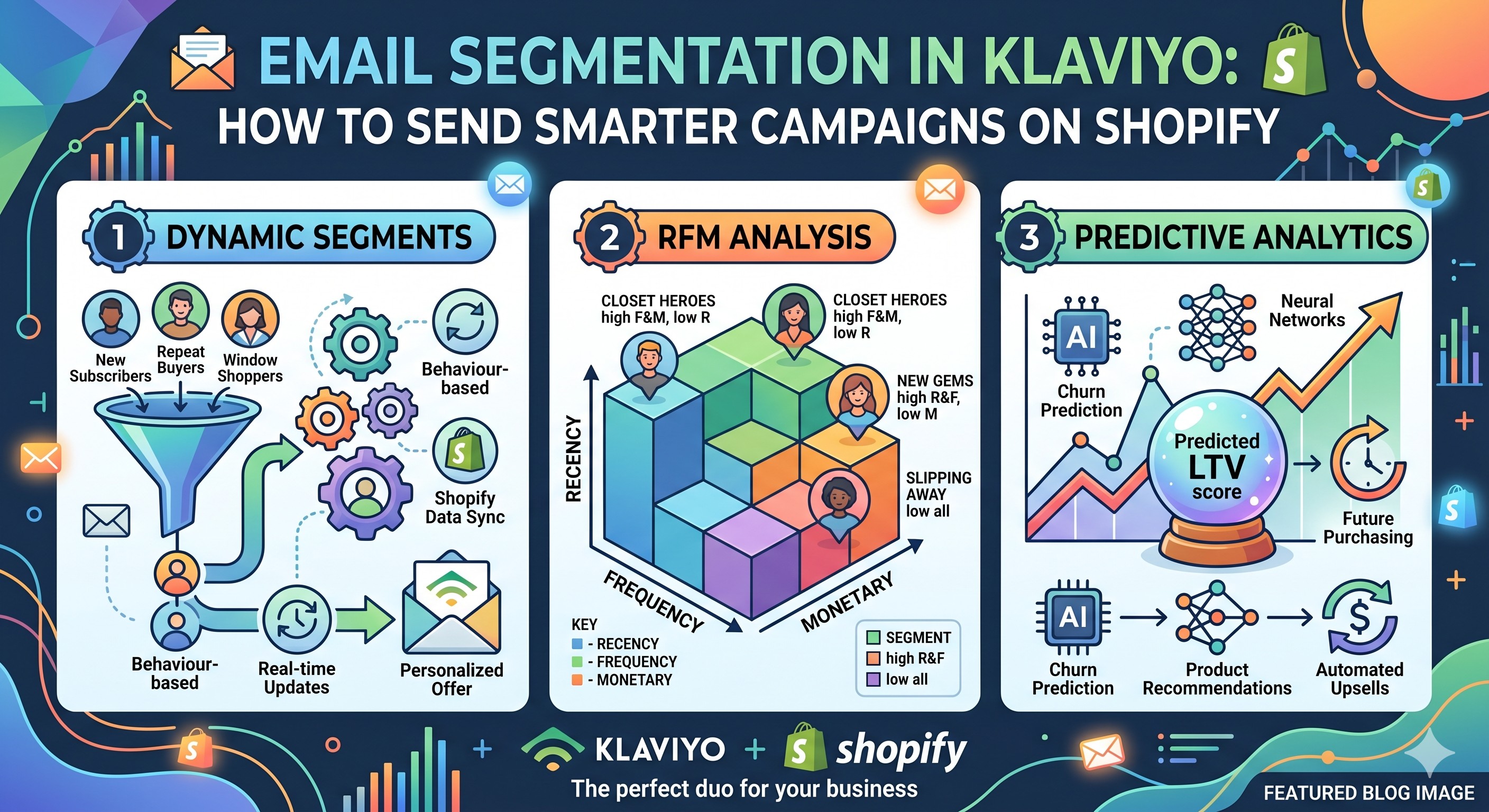
Once your foundational segments are running, Klaviyo's RFM analysis and predictive analytics unlock another layer. RFM stands for Recency, Frequency, and Monetary value, and Klaviyo automatically scores every customer on each metric. The platform then groups customers into categories like Champions, Loyal Customers, At Risk, and Hibernating.
The RFM report requires an ecommerce integration (Shopify works out of the box), at least 500 customers who have placed an order, 180 days of order history, and some customers with 3 or more orders. Once those thresholds are met, you can build segments off any RFM group with a single condition.
Klaviyo's predictive analytics layer adds two more powerful properties. The first is Customer Lifetime Value, which Klaviyo predicts based on historical data and retrains weekly. Use it to build a top-CLV segment for premium offers. The second is churn risk, expressed as a number between 0 and 1, where 0.7+ means high churn probability. Segment customers with high churn risk into a dedicated retention campaign before they ghost.
Practical example: a CLV-based segment of "predicted CLV over $300 AND placed order at least 2 times" gives you a high-value cohort that responds to subscription offers, loyalty perks, and product-development surveys. This is one of the highest-ROI segments most accounts never build.
How does Apple Mail Privacy Protection affect Klaviyo segments?
Apple Mail Privacy Protection inflates open rates by pre-fetching tracking pixels, even when a subscriber never opens the email. If your segments rely only on opens, you are including ghost subscribers who hurt deliverability. Fix it by adding click conditions or excluding Apple Privacy Opens directly inside your segment definitions.
Klaviyo gives you a built-in property called Apple Privacy Open that you can filter on. A reliable engaged segment looks like this: opened or clicked in the last 30 days AND (Apple Privacy Open equals false OR clicked email at least 1 time). That two-part filter weeds out passive Apple openers while still catching real engagement. Any segment driving a sunset or list-cleaning flow absolutely must use this filter, because otherwise you are sunsetting subscribers who actually do read your emails.
Common segmentation mistakes that quietly kill revenue
Segmentation is one of the easiest places to over-engineer. Here are the patterns that show up in nearly every audit we run.
Building too much too fast. Twelve segments built in week one rarely get used by week four. Start with three: active buyers, high-engagement non-buyers, and unengaged. Layer more as you actually need them for campaigns.
Sending only to the master list. This drags down deliverability fast. Inbox providers track engagement-to-send ratios. Sending to unengaged subscribers tanks the ratio and pushes future sends to spam, even for engaged readers.
Ignoring exclusions. Every campaign should exclude segments that should not receive that specific email. A new-customer welcome offer should exclude existing customers. A VIP launch should exclude one-time buyers.
Forgetting to filter by subscriber status. A profile can exist in Klaviyo without being subscribed (especially from Shopify integration), and accidentally sending to non-subscribers can trigger spam complaints. Always add Properties about someone: $consent equals subscribed to campaign segments.
Treating segments as static. Conditions you set three months ago may not reflect current product mix or buyer behavior. Quarterly review of top segments keeps the strategy aligned with the business.
How often should you update your Klaviyo segments?
Audit your top segments quarterly and after any major product launch, pricing change, or seasonal shift. Daily segment refresh is automatic in Klaviyo, but the logic behind your conditions needs human review every 90 days to stay aligned with current business priorities.
Run a quick health check by opening each segment and reviewing membership size, recent growth, and the campaigns sent to it. If a segment has stayed flat for two months, the conditions are probably outdated. If membership has tripled, you may need to split it into sub-segments to keep messaging tight. The work compounds. The brands we see hit the 32% email-attributed revenue benchmark almost all share the same habit: they treat segmentation as a living strategy, not a one-time setup.
The fastest revenue lever in Klaviyo is not a new flow or a fancy template. It is sending fewer, more relevant emails to the right segments. Start with the ten foundational segments above. Add RFM and predictive layers once you have order history and engagement data running. Audit quarterly and prune what is not working. If your segments feel cluttered or your campaign revenue has stalled, a Klaviyo audit is the fastest way to find what is leaking. The brands that get segmentation right pull ahead of competitors who still blast their whole list, and that gap widens every quarter.
Frequently Asked Questions
What is the difference between a list and a segment in Klaviyo?
A list is a static group of opt-in subscribers that only grows when people subscribe. A segment is a dynamic group built from conditions, like "purchased in the last 30 days," and updates automatically as subscribers' behavior changes. Use lists for collecting subscribers and segments for sending campaigns.
How many segments should a Shopify store have in Klaviyo?
Most Shopify stores need 10-15 active segments to cover campaigns, flows, and exclusions. Start with the core ten: 30-day engaged, 90-day engaged, VIPs, repeat buyers, one-time buyers, browse abandoners, engaged non-buyers, subscribers by source, lapsed customers, and sunset candidates. Add more only when you have a clear campaign use case.
Does Klaviyo segmentation work without Shopify?
Yes. Klaviyo segmentation works with any ecommerce platform or custom integration that sends order, browse, and email-engagement data. The Shopify integration is the deepest out-of-the-box experience, but BigCommerce, WooCommerce, Magento, and custom APIs all support full segmentation, including RFM and predictive analytics when data thresholds are met.
How accurate are Klaviyo's predicted CLV and churn risk?
Predicted CLV is most accurate for accounts with at least 500 customers, 180 days of order history, and customers with multiple purchases. Churn risk is updated weekly and improves as your dataset grows. Both should be used as directional signals for segmentation, not absolute truth.
What is the best engaged segment definition after Apple Mail Privacy Protection?
Use a hybrid definition: clicked email at least once in the last 30 days OR (opened email at least once in the last 30 days AND Apple Privacy Open equals false). This excludes ghost opens from Apple Mail prefetch while still capturing real engagement signals from non-Apple subscribers.