.avif)

TL;DR: Keep subject lines at 6 to 10 words (about 41 characters), name the product or offer, and match the flow trigger. Judge winners by click rate, not opens, since Apple Mail inflates nearly half of them. Below you'll find 60+ copy-paste subject lines for welcome, abandoned cart, promo, back-in-stock, post-purchase, winback, and BFCM sends, plus paste-ready Klaviyo tag syntax and a testing process that survives MPP.
For DTC brands on Klaviyo, a good subject line is 6 to 10 words, names the specific product or offer, matches the flow trigger that fired it, and gets judged by click rate, not Apple-inflated open rates. This Klaviyo subject line swipe file is built on that standard. Inside you'll find more than 60 copy-paste lines organized by flow and campaign type, the Klaviyo tag syntax to personalize them, and a testing method that still works now that half your opens are machine-generated.
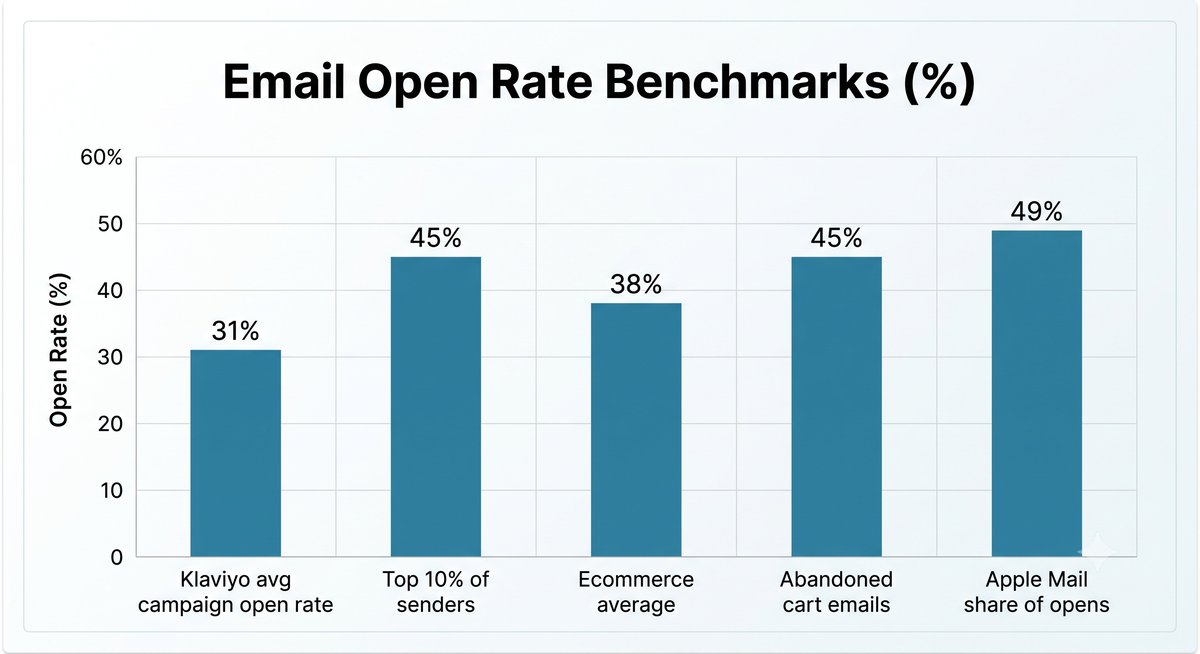
Here's why the line matters so much. The subject line is the only part of your email most subscribers ever see. Klaviyo's benchmark data puts the average campaign open rate around 31%, while the top 10% of senders reach 45.1%. Same platform, same inboxes. The gap comes down to who gets the email and what that one line says. Steal what's below, rewrite it in your brand voice, and test it against your current control.
What makes a line work?
A subject line works when it makes one specific promise the email keeps. Name the product, the discount, or the deadline. Specific numbers beat vague claims: "25% off ends tonight" outperforms "Huge savings inside" almost every time. Curiosity and questions earn opens too, but only when the payoff inside matches the setup.
Four formulas cover most winning lines:
- Offer plus deadline. "Free shipping ends at midnight." No mystery, high intent.
- Curiosity gap. "The one product we can't keep shelved." Works when the email delivers a real answer.
- Question. "Still thinking it over?" Questions read personal and pull replies.
- Social proof. "Why 12,000 runners switched to these." Numbers do the persuading.
Urgency and scarcity work because they're real triggers, not because they're tricks. If the sale genuinely ends Sunday, say so. If nothing is running low, don't claim it is. Subscribers remember fake countdowns, and the second one costs you trust and future opens.
Brand voice is the last filter. A playful skincare brand and a technical outdoor brand shouldn't send the same line. Every entry in this swipe file is a skeleton. Put your brand's skin on it before you hit send.
Best subject line length?
Aim for 30 to 50 characters, roughly 6 to 10 words. Research from Campaign Monitor and Marketo puts the sweet spot near 41 characters, about 7 words. The Gmail app on Android cuts subject lines at roughly 33 characters, per EmailToolTester, so front-load the payload.
That means the product name, the discount, or the deadline belongs in the first three or four words. "25% off sitewide ends tonight" survives truncation. "Tonight is your last chance to save 25% sitewide" gets its point amputated on half your list.
Preview text is your second subject line, and most brands waste it. In Klaviyo, fill the preview text field on every campaign and flow message. Don't repeat the subject. Extend it. If the subject says "Your cart expires at midnight," the preview should add "Free shipping is still applied." Together they give you two swings at the open instead of one.
The Klaviyo swipe file
Match the line to the trigger. A cart reminder should sound different from a sale blast, because the reader's intent is different. That's also why flows punch so hard: Klaviyo's 2025 benchmark report found flows drive about 41% of email revenue from just 5.3% of sends, roughly 18x more revenue per recipient than campaigns. If your Klaviyo flows aren't set up to catch these moments, fix that before you polish another subject line.
Welcome flow lines
Your welcome email lands at peak interest, usually seconds after someone hits your popup capture form. Deliver the incentive fast.
- Welcome in. Here's your 10% code
- You're in. Start here
- Your 10% off expires Sunday
- The 3 bestsellers everyone starts with
- Open this before you shop
- Why 40,000 customers started right here
- Your first order, sorted
- One code, zero fine print
Abandoned cart lines
Cart emails average around 45% opens, nearly double promo emails, according to Omnisend. Rejoiner's testing found "It looks like you left something behind" among the top-performing cart lines ever recorded, so it leads this list.
- It looks like you left something behind
- Still thinking it over?
- Your cart expires at midnight
- Forget something?
- Free shipping is still on the table
- Your size won't hold forever
- We saved your cart. For now
- Left this behind? It's moving fast
Promo and sale lines
Specific beats clever here. Name the number and the deadline. These are the skeletons we reuse most across email campaign management clients.
- 25% off ends tonight at midnight
- $20 off anything. No minimum
- 48 hours: sitewide 25% off
- Prices go back up Monday
- The sale you asked for is here
- Your early access starts now
- New markdowns just dropped
- Members see it first. That's you
Back-in-stock lines
The intent already exists. Your only job is speed and clarity.
- It's back. It won't last
- You asked. We restocked
- Back in stock: your saved size
- The waitlist is over
- Restocked once. Not promising twice
- Good news about the one you wanted
Post-purchase lines
The post-purchase window is where repeat buyers are made. Keep opens high without leaning on another discount.
- Your order's in. Here's what's next
- While you wait: 3 tips from our team
- You made a good call
- Quick question about your order
- Your order shipped. Track it here
- The right way to break these in
Winback lines
Winbacks work when they sound human. Honesty outperforms shouting.
- It's been a while. Here's 15% off
- Did we do something wrong?
- A lot's changed since your last order
- We saved your spot
- This is our last email (unless you say otherwise)
- Still want to hear from us?
BFCM and holiday lines
Inbox volume spikes hard during Cyber Week. Lines that name access, deadline, and discount depth cut through.
- Black Friday starts now for you
- Early access: 30% off everything
- Skip the lines. Shop the sale
- Cyber Monday ends at midnight
- Your VIP hour starts at 8pm
- The biggest sale we run all year
- Last call for December delivery
- Gift guide: under $50, ships free
Make lines Klaviyo-native
Generic listicles stop at words. Klaviyo lets you pull profile and event data straight into the subject line, which is where copy-paste lines turn into personalized ones.
Paste-ready tag syntax
The one rule: always set a fallback with the default filter, so profiles missing that data still get a clean line. These are ready to paste.
- {{ first_name|default:'Hey' }}, your 10% code is inside (welcome; renders "Hey, your 10% code is inside" when no name exists)
- Your {{ event.extra.line_items.0.product.title|default:'cart' }} is still waiting (abandoned checkout, Shopify Started Checkout event)
- {{ first_name|default:'Friend' }}, your size won't hold forever (abandoned cart)
- How to get the most from your {{ event.extra.line_items.0.product.title|default:'order' }} (post-purchase, Placed Order event)
- {{ first_name|default:'Hey' }}, still want these emails? (winback)
Event variable names vary by integration, so preview each message against a real event in Klaviyo's preview pane before you set the flow live. A subject line that renders a blank or a raw tag does more damage than a boring one.
Segment-aware variants
The same sale deserves different lines for different people. Take one 25% sitewide sale:
- VIPs (2+ orders, engaged): "Your early access opens tonight." Recognition drives this segment, not discounts.
- Engaged non-buyers: "25% off your first order. Today's the day." Lower the risk of the first purchase.
- 90-day lapsed: "Come back to 25% off everything." Reintroduce, then remove friction.
Build the three segments once in Klaviyo, clone the campaign, and swap the line. It's ten extra minutes per send and it's the cheapest lift in email.
Do emojis boost opens?
Sometimes, but they're seasoning, not strategy. One emoji can win attention in a crowded inbox and reinforce the offer, like a clock next to a deadline. The effect dies when every send uses one, and some clients render emojis inconsistently or clip them entirely.
Practical rules: one emoji maximum, placed at the start or end, never replacing a word. Skip them in winbacks and plain-text style sends, where a human tone is the whole play. And if your brand has never used an emoji anywhere else, the inbox is a strange place to start.
Will spam words hurt you?
Less than you've heard. Modern filters at Gmail and Yahoo grade sender behavior more than single words. Since their 2024 sender rules, the real risk is complaints: stay under a 0.3% spam-complaint rate and aim below 0.1%. One "FREE" won't sink you. Angry recipients will.
Litmus breaks down the requirements: the rules apply to senders at 5,000+ emails per day and demand SPF, DKIM, and DMARC authentication plus one-click unsubscribe. Mailgun's guidance lands in the same place.
So the modern spam-word warning isn't "avoid the word sale." It's this: all-caps lines, fake "RE:" prefixes, and bait-and-switch promises provoke the complaints and deletes that mailbox providers actually punish. If complaints are creeping up or campaigns keep landing in spam, that's a deliverability problem no subject line can outwrite.
How to A/B test in Klaviyo?
Test one variable per send, split the audience with Klaviyo's built-in A/B tool, and pick winners by click rate or revenue per recipient, not opens. Apple Mail accounts for about 49% of all opens, per EmailToolTester, and preloads emails nobody read. Klaviyo's Apple Privacy Open flag separates real opens from machine ones.
The working process:
- Campaigns: create an A/B test, change only the subject line, and split at least a few thousand recipients per variant. Smaller splits produce noise, not answers.
- Set the winner metric to clicks, and let the test run a full 24 hours so every time zone weighs in.
- Flows: use the message-level A/B option and let it run for weeks. Flow volume trickles in, so patience beats early calls.
- Log every result. Ten documented tests teach you more about your list than any swipe file, including this one.
Across the Shopify stores we manage at CartStrings, we average a 39% open rate, but no subject line gets crowned until clicks and revenue per recipient confirm it. If you're not sure whether subject lines or broken flow logic is your real bottleneck, a Klaviyo audit will tell you in a week.
Steal these, then test
Everything above follows one standard: 6 to 10 words, a specific promise, a match to the trigger, and a verdict from click rate rather than Apple-padded opens. Start with the three flows that earn the most, welcome, abandoned cart, and winback, and swap your current lines for swipe-file variants with proper default fallbacks. Then run one clean A/B test per campaign send and keep the log.
Subject lines are the cheapest test in ecommerce email, but they're also just the doorway. If you'd rather hand the whole email department to a team that does this daily, book a call with CartStrings and we'll show you exactly where your next 10% of email revenue is hiding.
Frequently Asked Questions
What's a good open rate?
Klaviyo campaigns average around 31%, and the top 10% of senders reach about 45%. Ecommerce-wide figures near 37.9%, reported by Threadpoint, are inflated by Apple's Mail Privacy Protection. Treat opens as directional and confirm real performance with click rate and revenue per recipient.
Does personalization work?
A first name alone lifts opens modestly and fades with overuse. Personalization tied to behavior works better: the product left in a cart, the item back in stock, or the category someone browses. In Klaviyo, always add a default fallback so profiles without a name still get a clean line.
Are opens reliable now?
Not on their own. Apple Mail drives roughly 49% of opens and preloads emails whether or not anyone reads them. Klaviyo marks these with its Apple Privacy Open property. Use opens for quick directional reads, then judge winners by clicks and revenue.
What words should I avoid?
No single word sends you to spam anymore. All-caps lines, fake "RE:" prefixes, and promises the email doesn't keep are the real danger, because they provoke complaints. Gmail and Yahoo throttle senders who cross a 0.3% complaint rate, so write lines your email can honestly deliver on.
How long should lines be?
Six to ten words, or roughly 30 to 50 characters. Campaign Monitor and Marketo research centers the sweet spot near 41 characters. Since the Gmail Android app truncates around 33 characters, put the product or offer in the first few words.