.avif)


TL;DR: Klaviyo predictive analytics forecasts six customer-level metrics, including predicted CLV, churn risk, and expected next order date, using machine learning built into every Klaviyo account. You need 500+ paying customers, 180 days of order history, recent orders, and some repeat buyers to unlock it. Predictions are most reliable at the segment level, not per person. Used right, they power VIP segments, winback triggers, and replenishment flows that drive real revenue.
Klaviyo predictive analytics is a built-in machine learning feature that forecasts six customer-level metrics, including predicted CLV, churn risk, and expected next order date, for any Shopify store with 500 or more paying customers and 180 days of order history, at no extra cost.
Every profile in your account gets these predictions automatically. No data science team. No add-on fee. The model runs quietly in the background and retrains at least once a week.
Most guides stop at the definitions. This one goes further. You'll get the exact segment recipes we build for revenue, with the field, operator, and threshold for each one. You'll also get the honest version of what these predictions can't do, because they mislead badly in a few common situations, like one-time buyers and subscription orders.
Here's everything you need to know, from unlock requirements to the flows that turn forecasts into orders.
Klaviyo predictive analytics
Klaviyo's predictions come from machine learning models trained on your store's order history. The models study how often customers buy, how much they spend, and how long they go between orders. Then they project that behavior forward.
You'll find the results on any customer profile under the Metrics & Insights tab. Open a profile, click the tab, and the predicted values sit right there next to the customer's real history. The same predicted metrics also appear in the Helpdesk panel, so support agents can see a customer's value before answering a ticket.
The best part is the price. Predicted CLV and its sibling metrics cost nothing extra. They're baked into Klaviyo. If your account meets the data requirements, the predictions are already sitting there, whether you use them or not. Most stores don't. That's the gap this guide closes.
What are the six metrics?
Klaviyo predicts six things about each customer: predicted customer lifetime value, churn risk, expected date of next order, average time between orders, predicted number of orders, and predicted gender. Historic CLV sits alongside them, and Total CLV adds historic and predicted together.
Here's what each one means in practice:
- Predicted CLV. The dollar amount Klaviyo expects this customer to spend over the next 365 days.
- Historic CLV. What they've already spent. Total CLV is Historic plus Predicted.
- Churn risk. The probability, from 0 to 1, that the customer won't order again.
- Expected date of next order. When their next purchase should land, based on their buying rhythm.
- Average time between orders. The typical gap between this customer's purchases.
- Predicted number of orders. How many orders Klaviyo expects in the prediction window.
- Predicted gender. Inferred from first name matched against census data. It returns male, female, or uncertain. Use it for creative splits, never for anything sensitive.
The expected date of next order deserves one extra note. Klaviyo's documentation shows it uses the average gap between a customer's three most recent orders. Customers with only one order get the store-wide median instead, which is why that date looks identical across your one-time buyers.
How do you unlock it?
You need four things: at least 500 customers who've placed an order, 180 days of order history, at least one order in the last 30 days, and some customers with three or more orders. Miss any one and the predicted fields stay empty.
Each requirement exists for a reason. The model needs 500 paying customers to find patterns instead of noise. It needs 180 days of history to see buying cycles. It needs orders in the last 30 days to confirm the store is active. And it needs repeat buyers because a model can't learn repurchase behavior from a list of people who each bought once.
Klaviyo's help doc on understanding predictive analytics covers the full requirements list. If your predictions aren't showing, this checklist is almost always why. New stores just need time. Stores that migrated to Klaviyo recently should sync full historical order data from Shopify, not just orders since the switch. And a store that went quiet for a month will see predictions pause until orders resume.
How is predicted CLV built?
Predicted CLV estimates what a customer will spend over the next 365 days. Total CLV equals Historic CLV plus Predicted CLV. The model weighs order frequency, recency, and spend, and it retrains at least once a week as new orders come in.
That weekly retraining matters. A customer who just placed their third order this month will look very different next Monday than they did last Monday. Don't screenshot predicted values and treat them as fixed. They move.
The 365-day window is the default. As of 2025, accounts on Klaviyo's Advanced Data Platform with Marketing Analytics can set a custom CLV prediction window, which helps brands with long repurchase cycles like furniture or skincare devices.
One honest caveat before you build anything: predicted CLV is ranking-accurate more than dollar-accurate. A customer predicted at $180 is almost certainly worth more than one predicted at $12. But neither number is a promise. Treat predicted CLV as a sorting tool that ranks your list from best to worst, and it performs. Treat it as a forecast you can invoice against, and it will disappoint you.
What is a good churn risk?
Churn risk is a probability between 0 and 1. A score of 0.45 means a 45% chance the customer won't buy again. There's no universal good number. Most profiles sit above 0.5 because most ecommerce customers only buy once or twice.
So don't open your account, see churn risk over 50% everywhere, and panic. That's normal. The metric only becomes useful when you read it relative to your own store.
Here's the practical read for repeat buyers. Under 0.4 is healthy. Between 0.5 and 0.7 is drifting. Above 0.7 means act now, because the window to win them back is closing. Across the Shopify stores we manage at CartStrings, we typically treat 0.7 as the trigger line for winback offers aimed at proven repeat customers, and we see the strongest recovery rates when the message lands before the score climbs past 0.85.
For one-time buyers, ignore the absolute number and lean on recency and engagement instead. Their churn scores run high by design.
Segment recipes that pay
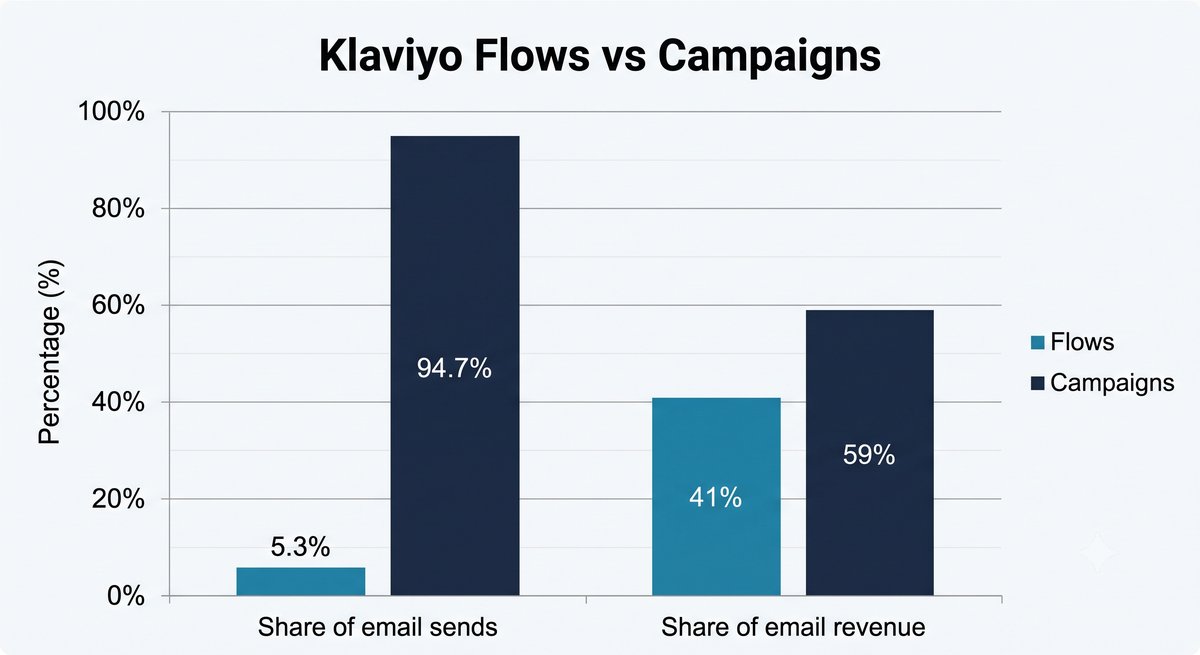
This is where predictions turn into money. Klaviyo's 2025 ecommerce benchmarks show flows drive roughly 41% of email revenue from only about 5.3% of sends, and flow revenue per recipient runs around 18x what campaigns produce. Predictive metrics are how you aim those flows. Here are the four builds we use, with the exact field, operator, and threshold.
1. Predicted VIPs. Field: Predicted Lifetime Value. Operator: is at least. Threshold: $150, or roughly 3x your average order value. These are your future best customers before they've fully proven it. Give them early access and launch-first treatment in your email campaigns, not discounts.
2. High-value at-risk winback. Fields: Churn risk is greater than 0.7, AND Historic CLV is at least $100, AND Placed Order last more than 60 days ago. This isolates proven spenders who are slipping away. Size the winback offer to their value. A $400 customer earns a better save attempt than a $40 one.
3. Replenishment flow. Trigger type: date property. Property: Expected Date of Next Order. Timing: start 5 days before the date. The email lands right as the customer is due to run out, which is why this build outperforms fixed 30-day reminders. It's one of the highest-ROI email automations a consumable or repeat-purchase brand can run.
4. Sunset saver. Fields: Churn risk is greater than 0.9, AND no email opens or clicks in the last 120 days. Send one last-chance message, then suppress non-responders. Your deliverability improves and your open rates stop lying to you.
When predictions mislead
The rule that governs everything: Klaviyo's predictions are segment-accurate, not individual-accurate. A segment of 2,000 high-predicted-CLV customers will reliably outspend a segment of 2,000 low ones. Any single customer's number can be wrong. Build strategies on groups, never on one profile.
Beyond that rule, four situations break the model:
Mostly one-time buyers. If 85% of your list bought once, churn risk runs high across the board and expected next order dates default to the store median. The predictions aren't wrong, but they're not saying much. Don't blast panic discounts at a "high churn" segment that was never coming back anyway.
Under 500 customers. You're locked out below the threshold, and accounts just above it get thin, wobbly predictions. Revisit the numbers after a few hundred more orders.
Seasonal and giftable products. A customer who buys a gift every December looks churned by July. Gap-based math falls apart when purchases follow a calendar instead of a consumption cycle. Layer date-based filters over predictive ones for these catalogs.
Subscription orders. Auto-generated recurring orders inflate predicted order counts and crush average time between orders. A replenishment flow aimed at active subscribers is worse than useless. Exclude subscribers from prediction-driven flows and read their metrics separately.
If you're not sure whether your segments rest on solid predictions or broken ones, a Klaviyo audit will surface it fast.
The bottom line
Klaviyo predictive analytics gives every qualifying Shopify store a free forecasting layer: predicted CLV, churn risk, next order dates, and more, retrained weekly on your own data. Use it at the segment level. Build the four recipes above. Respect the failure cases, especially subscriptions and seasonal buyers, and the feature quietly becomes one of your best revenue tools.
Across the stores we manage at CartStrings, prediction-driven segments and flows are a core reason clients average 32% email-attributed revenue. If you'd rather have a team that builds this for you, book a call and we'll walk through your account together. Or keep learning with more Klaviyo guides on our blog.
Frequently Asked Questions
How does Klaviyo predict CLV?
Klaviyo uses a machine learning model trained on your store's order history. It weighs order recency, frequency, and spend to forecast what each customer will spend over the next 365 days. The model retrains at least weekly, so the numbers shift as new orders arrive.
Why is my data not showing?
Your account is missing one of four requirements: 500 customers who placed an order, 180 days of order history, an order within the last 30 days, or enough customers with three or more orders. New stores usually just need time. Migrated stores should sync full Shopify order history, not just recent orders.
How accurate is predicted CLV?
Predicted CLV ranks customers well but doesn't nail exact dollar amounts. A customer predicted at $200 is very likely worth more than one predicted at $20, but neither figure is guaranteed. Build segments on the rankings and the metric performs reliably.
Historic vs predicted CLV?
Historic CLV is what a customer has already spent with you. Predicted CLV is what Klaviyo expects them to spend over the next 365 days. Total CLV adds the two into a single lifetime value number.
Does it cost extra?
No. Predictive analytics is built into Klaviyo at no additional cost. Once your account meets the data requirements, predicted metrics appear on every profile automatically. Only the custom CLV prediction window requires the Advanced Data Platform tier.