.avif)


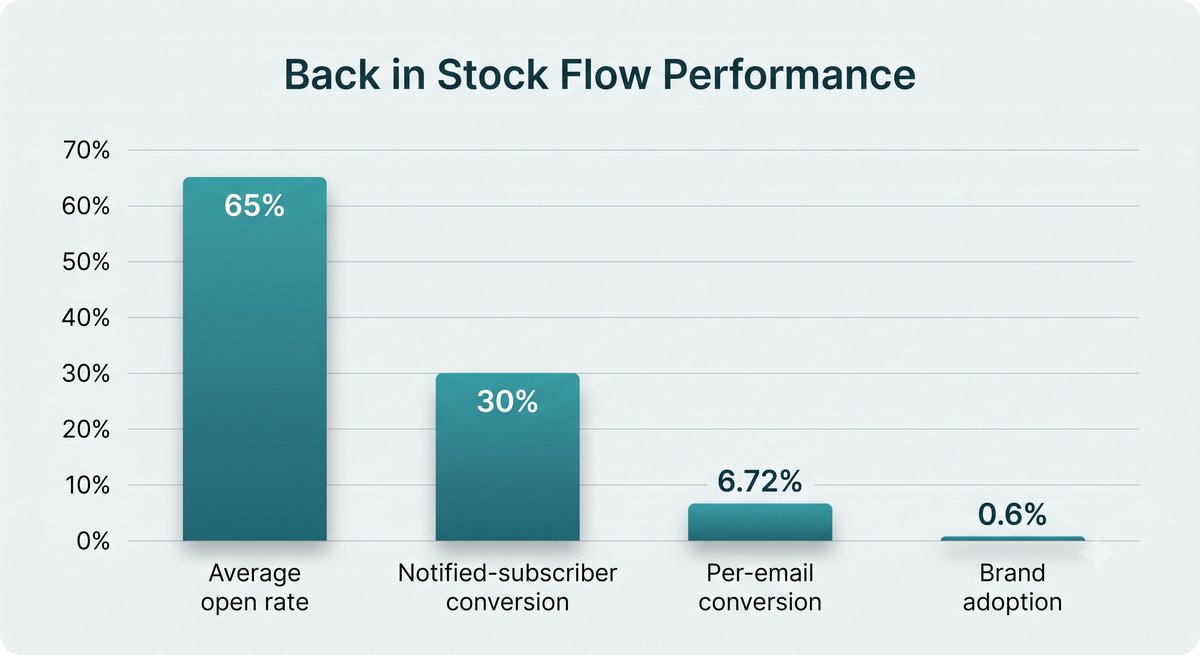
TL;DR: A Klaviyo back in stock flow emails or texts shoppers the moment a sold-out item returns. It's the highest-earning automation in ecommerce at $9.14 per email and 6.72% conversion, yet only 0.6% of brands run one. Setup takes under an hour: turn on Shopify inventory tracking, add the opt-in form to sold-out pages, build from Klaviyo's template, and batch your sends to match inventory.
A Klaviyo back in stock flow is an automation that emails or texts shoppers who joined a waitlist the moment a sold-out product returns, converting between 6% and 22% for Shopify brands because every recipient has already asked to buy. That makes it the single most efficient message in your Klaviyo account. Nothing else you send goes to a list made entirely of people who requested it.
Here's why it matters. Research from AMRA & Elma found that 63% of shoppers never come back after hitting a stockout. They wanted your product, you didn't have it, and they bought elsewhere. Every sold-out product page without a waitlist button is quietly handing revenue to competitors.
The fix is fast and nearly free. This guide walks through the exact setup: Shopify prerequisites, the opt-in form, the flow build, batching settings, and troubleshooting. It also covers what most guides skip, which is the revenue math, the demand-forecasting signal hiding in your waitlists, and why batching protects your sender reputation.
Klaviyo Back in Stock Flow 101
The flow has three moving parts. A shopper taps "Notify me when available" on a sold-out product page. Klaviyo records that as a Subscribed to Back in Stock event on their profile. When Shopify reports the item restocked, Klaviyo releases the waitlist and sends the alert.
One technical rule matters more than any other: the flow must be triggered by Klaviyo's own Subscribed to Back in Stock metric. Custom metrics can't trigger it, and Klaviyo recommends leaving trigger filters and flow filters off entirely, since everyone who subscribed intended to hear back. The official Klaviyo guide to building a back in stock flow covers the trigger requirements in detail.
Also worth knowing: Klaviyo never tracks inventory itself. It listens to your Shopify catalog. If Shopify doesn't report accurate stock levels, Klaviyo has nothing to act on, which brings us to the setup step most brands get wrong.
Get Shopify Tracking Right
Before you touch the flow builder, check two Shopify settings on every product you want covered.
First, Track quantity must be turned on. Klaviyo can't detect a restock on a product Shopify isn't counting.
Second, Continue selling when out of stock must be turned off. If Shopify keeps selling past zero, the product never registers as out of stock, the opt-in button never appears, and the trigger never fires. There's no error message. The flow just sits there doing nothing.
This silent failure is the number one reason back in stock flows produce zero revenue. Audit your catalog before launch, not after. A quick bulk edit in Shopify admin handles both settings across your full product list in minutes.
How do shoppers opt in?
Shoppers opt in through a "Notify me when available" button on the sold-out product page. Klaviyo shipped a no-code form builder for this in Q3 2025, so you can add the button without touching theme code. Each submission fires the Subscribed to Back in Stock event that triggers your flow.
Demand for this is higher than most owners expect. AMRA & Elma research shows 48% of shoppers would sign up for restock alerts when offered. Nearly half your sold-out traffic is willing to hand over contact info if you just ask.
Placement matters. Put the button exactly where "Add to cart" normally sits, so the shopper's intent transfers straight into the form. Keep the form to one field, email only, or email plus an optional phone field if you run SMS. Every extra field cuts submissions.
There's a bonus here too: shoppers who weren't on your list yet become subscribers, which grows your file with your highest-intent visitors. If your broader capture setup is weak, a dedicated popups and email capture rebuild compounds the same effect across the whole site.
How do you build the flow?
Build it from Klaviyo's pre-built template. Create a new flow, search "back in stock," and keep the default Subscribed to Back in Stock trigger. Add one email with the product image, a short urgency line, and a single CTA back to the product page. That's a complete, working flow.
The template includes a back in stock delay, which is what makes this flow different from every other automation. The delay holds each subscriber in the flow until Klaviyo sees the item restocked in Shopify, then releases them for sending. Don't replace it with a normal time delay. It's doing the inventory-watching for you.
For the email itself, resist the urge to overdesign. Back-in-stock emails average around 65% open rates, roughly double a typical campaign, because the recipient asked for this exact message. Best practices:
- Subject line names the product. "The Cloud Hoodie is back" beats anything clever.
- One CTA. A single button to the product page. No collection links, no cross-sells above the fold.
- Honest urgency. "Restocked in limited quantities" works because it's usually true. These items sold out once already.
- Product image up top. The shopper recognizes what they wanted in half a second.
A second reminder email 24 hours later, sent only to non-purchasers, is a reasonable addition once the first email proves out. If you want the full flow library built to this standard, that's the core of our email automations service.
Klaviyo Back in Stock Flow ROI
Here's the math almost nobody runs before dismissing this flow as a nice-to-have.
The model is simple: sold-out product page sessions x opt-in rate x notified conversion x AOV. Say your store logs 2,000 sessions on sold-out pages each month. At the 48% opt-in rate shoppers report being willing to give, that's up to 960 waitlist signups. Industry planning benchmarks project a 500-person waitlist to roughly 125 to 175 purchases, a 25% to 35% notified conversion. Scale that to 960 subscribers and you're looking at 240 to 336 orders. At a $70 AOV, that's $16,800 to $23,520 in monthly revenue from one automation.
Even the conservative floor is strong. Per Omnisend's 2026 email marketing statistics, back-in-stock automations earn $9.14 in revenue per email sent and convert at 6.72%, the highest of any automation they measured. Yet only 0.6% of brands use them. A MarketingSherpa case study recorded 22.45% conversion on back-in-stock alerts. The gap between how well this flow performs and how few brands run it is the closest thing to free money in Klaviyo. Across the Shopify stores we manage at CartStrings, we typically see back in stock land among the top three flows by revenue per recipient within the first month.
Waitlists as demand signals
Your waitlist is also a purchasing tool. Every Subscribed to Back in Stock event is a pre-order signal from a real customer, tied to a specific variant. Sort your variants by waitlist count and you have a ranked reorder list built from demonstrated demand, not gut feel. A size medium with 400 subscribers gets reordered deep. A colorway with 12 subscribers gets cut. You can also bring those counts to suppliers to justify larger runs or faster turnaround.
Batching protects two things
Klaviyo's notification settings let you set customers to notify per unit restocked and a wait time between batches. Sends also stop automatically when inventory drops below a minimum threshold you define.
These settings solve two expensive problems at once. First, overselling: if 40 units come back and you blast 3,000 subscribers, you'll sell out in an hour and spend the next week issuing refunds to angry customers. Notifying two or three people per unit keeps demand matched to supply. Second, deliverability: a sudden send spike from your domain looks like spam behavior to Gmail and Yahoo. Spacing batches keeps your volume curve smooth and your sender reputation protected, which is what keeps every other flow and campaign landing in the inbox too.
Email or SMS for restocks?
Run both. Email is the default channel, and SMS catches profiles who never gave you an email or rarely open one. In one Klaviyo client example, restock emails converted at 7.9% while SMS hit 8.5%. Klaviyo handles the split natively, texting the profiles that can't receive email.
The setup uses a conditional split after the back in stock delay. The split checks whether the person can receive email. If yes, they get the email. If no, they drop to the SMS branch and get a short text: product name, "back in stock," link. That's it.
Two cautions. SMS requires explicit consent, so only text subscribers who opted in to texts. And enable quiet hours, because a 2 a.m. restock sync shouldn't wake your customers.
Why is the flow not sending?
Nine times out of ten, a dead back in stock flow traces to Shopify settings: Track quantity is off or Continue selling when out of stock is on. Both kill the trigger silently. Check those first, then confirm the flow is Live and the trigger is the Subscribed to Back in Stock metric.
Full troubleshooting checklist, in order:
- Flow status is Live, not Draft or Manual.
- Trigger is the Klaviyo metric Subscribed to Back in Stock. A custom metric in that slot will never fire.
- No trigger or flow filters are quietly excluding subscribers.
- Inventory is above your minimum threshold. Sends stop below it by design.
- Shopify settings are correct on the specific variant, not just the parent product.
To test end to end: set a test product's inventory to zero, subscribe with your own email from the live product page, then restock it in Shopify admin. Within minutes you should see the event on your profile in Klaviyo and a send in the flow analytics. If the event appears but no email sends, the problem is inside the flow. If the event never appears, the problem is the form or Shopify settings. And if you'd rather have someone trace it for you, a Klaviyo audit will surface this plus every other leak in the account.
The flow that pays for itself
The back in stock flow is the rare project where the data is lopsided: highest revenue per email of any automation, 65% open rates, conversion between 6.72% and 22.45% depending on the study, and 99.4% of brands still ignoring it. The build is an afternoon of work. Fix your Shopify tracking settings, add the notify form, launch the template with one strong email, set your batching, and test it once.
Then keep watching the waitlists, because they'll tell you what to reorder before your sales reports do. If you'd rather hand the whole email system to a team that does this daily, CartStrings runs email for Shopify brands doing $500k+ and averages 32% email-attributed revenue. Book a call or browse more guides like this one in our articles library.
Frequently Asked Questions
Does Klaviyo have this flow?
Yes. Klaviyo includes a native back in stock flow template triggered by its built-in Subscribed to Back in Stock metric, plus a no-code form builder for the "Notify me when available" button. No third-party restock app is required for Shopify stores. You need the Shopify integration connected and inventory tracking enabled.
Why won't my flow send?
The most common cause is Shopify settings: Track quantity must be on and Continue selling when out of stock must be off, or the trigger fails silently. After that, check that the flow is Live, the trigger is the Subscribed to Back in Stock metric rather than a custom metric, and inventory sits above your minimum send threshold. Klaviyo stops sends when stock falls below that line.
Should alerts be email or SMS?
Use both channels. Email carries most of the volume, and a conditional split texts profiles who can't receive email so no subscriber is missed. Performance is close between the two: one Klaviyo client example showed restock emails converting at 7.9% and SMS at 8.5%. SMS requires its own opt-in consent.
Do alerts need a discount?
No. The recipient already asked to buy this exact product, which is why these emails open at roughly 65% and convert without incentives. A discount here gives away margin you don't need to spend and trains customers to wait for deals. Honest scarcity, like noting a limited restock quantity, does more than a coupon.
What conversion is typical?
Industry data puts average back-in-stock conversion at 6.72%, the highest of any ecommerce automation, and one published case study reached 22.45%. Real client examples commonly land in the 7% to 9% range per send. Measured against the full waitlist rather than per email, plan on 25% to 35% of notified subscribers purchasing.