.avif)

TL;DR: A Klaviyo BFCM playbook means starting list and deliverability prep 8-12 weeks out, segmenting by purchase history and engagement, running a teaser-to-Cyber-Monday send calendar with SMS as a required channel, and ramping volume gradually instead of blasting your whole list on Black Friday morning. Pair that with a week-by-week deliverability warm-up and a structured post-BFCM retention plan, and you protect your sender reputation while capturing the biggest revenue weekend of the year.
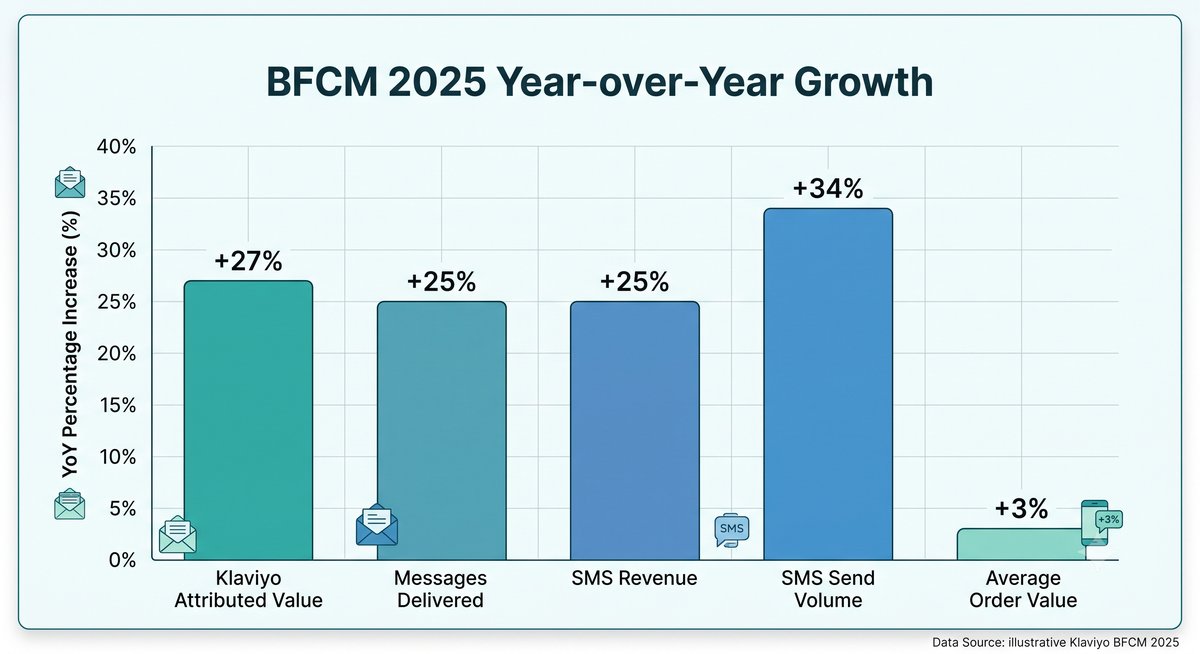
Klaviyo BFCM means running a structured, weeks-long email and SMS program that ramps send volume gradually, segments contacts by engagement and purchase history, and layers in SMS to capture the biggest revenue weekend of the Shopify calendar. Klaviyo's own data shows how big that weekend has gotten: BFCM 2025 customers surpassed $3.8 billion in Klaviyo-attributed value, up 27% year over year, with Black Friday alone driving over $1 billion and 22.7 billion messages delivered, a 25% jump from the year before.
That volume rewards brands that plan early and punishes the ones that don't. Wait until mid-November and you're behind on segmentation, your domain isn't warmed up, and your flows still run on default settings. This playbook covers when to start, how to segment, your send calendar, why SMS isn't optional, and the week-by-week deliverability plan that protects your inbox placement during your biggest weekend of the year.
When to start BFCM prep?
Start your Klaviyo BFCM prep in early October, roughly 8-12 weeks before Black Friday. Klaviyo's own sending data shows brands that began campaigns in October with a weekly cadence were about 3x more likely to land as top performers during the actual BFCM weekend.
That early start does two jobs at once. It builds list engagement so your BFCM sends land with an audience that already opens and clicks, and it gives your account time to ramp volume without tripping spam filters. Waiting until November means warming up your list and selling inventory in the same three weeks, a losing trade-off. If you're not sure where your program stands, a Klaviyo audit can show you what needs fixing before the calendar gets tight.
How to segment for BFCM?
Segment your BFCM list into three tiers: purchase history (first-time vs. repeat buyers), engagement (opened or clicked in the last 30-90 days), and VIP status (top spenders or highest order frequency). Each tier gets different timing, messaging, and offers.
Purchase history tells you who to push toward a second sale versus who needs a first-purchase incentive. Engagement tells you who gets your full send cadence versus who gets fewer touches to protect deliverability. VIP tiers, usually your top 10-20% by lifetime spend, get early access and better perks. Building these segments takes real setup work: custom properties, purchase-count filters, and engagement-based segments that update in real time. Across the Shopify stores we manage at CartStrings, we typically see accounts with clean segmentation pull noticeably higher revenue per email than accounts sending one blast to everyone.
The BFCM send calendar
Your BFCM calendar should run teaser campaigns in early November, VIP early access 3-5 days before Black Friday (Tuesday through Thursday sends outperform), a Black Friday morning launch, weekend reminders, and a distinct Cyber Monday push.
Don't reuse the same offer messaging across all five touches. Teasers build anticipation without revealing the full discount. VIP early access rewards loyalty and gives your best customers first pick of inventory. Black Friday morning is your biggest single send. Weekend reminders target cart abandoners and non-openers with a different subject line. Cyber Monday should feel like a fresh angle, not a rerun, often positioned around "last chance" framing. Plan the whole sequence in Klaviyo's calendar view before October ends so your team isn't building emails under pressure during launch week.
How does VIP access work?
VIP early access means giving top-spending or most-frequent customers a 24-72 hour head start on Black Friday deals, sent 3-5 days before Black Friday, ideally Tuesday through Thursday. It's the highest-converting segment of the whole BFCM calendar.
VIP treatment does more than move product early. It reduces support strain on Black Friday morning by spreading demand across days instead of one spike, and it reinforces loyalty for the customers who drive the most repeat revenue. Define VIP using Klaviyo's predictive analytics or a manual lifetime-spend threshold, then build a dedicated flow that references their status directly in the copy. Generic "you're special" language falls flat. Naming the specific reason (top 5% of customers, three or more past orders) makes the early access feel earned.
Is SMS required for BFCM?
Yes. SMS revenue grew 25% year over year during BFCM 2025 as send volume rose 34%, and Klaviyo reports brands that added SMS to their mix saw roughly a 20% year-over-year revenue lift. Skipping SMS leaves real revenue on the table.
SMS works during BFCM because inboxes get flooded but phones don't get the same volume of competing messages. Use it for the highest-urgency moments: VIP alerts, Black Friday morning launch, and final-hours Cyber Monday reminders. Keep SMS volume lower than email (2-4 messages across the weekend versus 5-8 emails) since texts feel more intrusive at high frequency. If SMS isn't built into your popup and checkout capture flow yet, fix that well before October, since your SMS list needs the same lead time as your email list. A stronger popup and capture strategy now means a bigger SMS list by November.
Deliverability warm-up plan
Most BFCM guides skip this, and it's where accounts lose the most revenue. Deliverability failures during BFCM almost always come from sudden volume spikes, not bad content. Klaviyo's own deliverability guide points to spike-driven reputation damage as the top cause of BFCM inbox placement problems, and the fix is a sequenced timeline, not a single tactic.
Here's the week-by-week plan we run for $500k+ Shopify accounts:
Weeks 1-4 (early September, roughly 3 months out): Start warming your sending domain and building reputation now if you haven't already. Klaviyo's help documentation is direct here: sender reputation needs a runway of at least three months before your highest-volume weekend. Send consistent, moderate-volume campaigns to your most engaged contacts, and don't let any flow go quiet.
Weeks 5-8 (early to mid-October): Begin your volume ramp. Increase send frequency and list size gradually, roughly 15-25% more per week, prioritizing recently-engaged contacts first. Finalize segmentation tiers and build out teaser and VIP campaigns.
Weeks 9-10 (early November): Push toward your expected BFCM peak. By now you should be sending at 60-80% of projected Black Friday volume so launch day isn't a shock to inbox providers. Pause your sunset or suppression flow around two weeks before Black Friday so re-engaged contacts aren't purged right before your biggest sends.
BFCM weekend itself: Monitor deliverability in real time, hour by hour, not day by day. A reputation problem Friday morning can tank Saturday and Sunday sends if you don't catch it fast. If complaint rates spike, cut volume to your least-engaged segments immediately rather than waiting for the next scheduled send. This is triage, and it's the difference between an account that recovers by Monday and one still fighting spam folders in December.
Weeks 1-3 post-BFCM (early to mid-December): Reputation repair time. Suppress non-engagers who didn't open or click during BFCM. Resume your sunset flow around two weeks after Black Friday, once volume normalizes. Expect roughly three weeks of cleanup before your sending patterns look normal to inbox providers again.
Treating these as one continuous timeline, not three separate projects, is what protects your Klaviyo BFCM revenue. If your account doesn't have a formal plan yet, our deliverability service builds this timeline around your send history and list size.
Which flows need BFCM fixes?
Your abandoned cart and welcome series need BFCM-specific adjustments before the weekend hits, since default flow timing and copy won't reflect your holiday offers or urgency. Update flow copy, timing, and discount logic at least two weeks before Black Friday.
Abandoned cart flows should reference your BFCM offer directly instead of running generic recovery copy, and you may want to shorten the delay before the first email since urgency runs higher during BFCM. Welcome flows for subscribers who join during your teaser period need a BFCM-aware first email, not a standard "here's 10% off" message that ignores the fact they signed up during your biggest sale. Post-purchase flows matter too: research from Fluency Firm found customers who get a post-purchase welcome email are 2.4 times more likely to buy again within 60 days. If your flows haven't been reviewed since last year's BFCM, this is the moment.
Tiered vs blanket discounts?
Tiered discounts (spend more, save more) protect margin better than a blanket percentage off, and they lift average order value. Klaviyo's BFCM 2025 data shows average selling price rose 4.8%, lifting overall AOV about 3% across the weekend, a trend tiered offers reinforce.
A blanket 20% off everything is easy to communicate but leaves money on the table with customers who would have paid full price or bought more to hit a higher tier. A structure like 15% off $75, 20% off $150, 25% off $250 pushes customers to add items to reach the next level. Use dynamic content blocks to show each segment the tier that fits their typical order value, rather than one static offer for everyone.
Using dynamic content
Dynamic content lets you show different product recommendations, offer tiers, and hero images based on a contact's segment or purchase history, all within a single campaign send. This matters more during BFCM than any other time of year because inbox competition is highest.
Swap product blocks based on category affinity (someone who bought skincare sees skincare deals, not accessories), and use conditional blocks to show VIP messaging only to your top segment within the same send. This cuts the number of separate campaigns you need to build while keeping each send targeted. Your Black Friday morning email doesn't need five versions, just one campaign with smart content logic underneath.
Post-BFCM retention flows
Post-BFCM retention flows convert one-time holiday shoppers into repeat customers, and they matter because most BFCM buyers won't naturally come back on their own. A dedicated post-purchase flow with a real welcome sequence makes a measurable difference in 60-day repeat purchase rate.
Build a thank-you flow specifically for BFCM buyers, distinct from your standard post-purchase series. Reference the sale they shopped, set shipping expectations given holiday volume, and introduce your brand story if they're a first-time buyer acquired through a discount. Follow with a replenishment or complementary-product flow 2-3 weeks later. This is also when you clean your list: remove hard bounces, suppress deep non-engagers, and reset your sunset flow so your account enters the new year with a healthier reputation, not a bloated list dragging down engagement.
Using last year's BFCM data
Your prior year's campaign reports are the single best input for this year's plan. Pull open rates, click rates, and revenue per campaign by segment, then use that to set realistic send times, subject lines, and which segments deserve more frequency this year.
Look at which send times got the best engagement, which subject lines drove opens, and where unsubscribe or complaint spikes happened. If you saw a reputation dip last December, ramp volume more conservatively this year. If a segment barely opened anything, consider suppressing them from your highest-volume sends rather than risking your sender score.
Running this whole playbook manually, across segmentation, calendar building, deliverability monitoring, and post-BFCM cleanup, is a lot for one person alongside actually running a store. If you want help building or auditing your Klaviyo BFCM program before the season gets tight, book a call with CartStrings and we'll walk through where your account stands today. You can also browse more Klaviyo strategy breakdowns in our articles library.
Frequently Asked Questions
When should I start prep?
Start 8-12 weeks before Black Friday, ideally in early October, with actual reputation and domain warm-up beginning up to three months out if your sending history is thin. Klaviyo's sending data shows brands starting campaigns in October with a weekly cadence were about 3x more likely to be top BFCM performers. Waiting until November compresses list warm-up and holiday selling into the same few weeks, which hurts both.
How many BFCM emails to send?
Most $500k+ Shopify brands send 5-8 campaign emails across the full BFCM weekend (teaser, VIP early access, Black Friday morning, one or two weekend reminders, and Cyber Monday), plus 2-4 SMS messages for the highest-urgency moments. The right number depends on list engagement and segment; your most engaged contacts can handle more touches than your least engaged ones.
Protecting sender reputation?
Ramp your send volume gradually over 2-4 weeks before BFCM instead of jumping straight to peak volume on Black Friday morning, and never let flows go fully quiet in the weeks before the weekend. Klaviyo's deliverability guidance points to sudden volume spikes as the top cause of BFCM inbox placement failures. Prioritize recently-engaged contacts first and monitor bounce and complaint rates in real time during the weekend itself.
% of revenue from email/SMS?
Email and SMS drove 42% of total BFCM 2025 revenue, rising to 43% on the single highest-volume days of the weekend, according to Klaviyo's own BFCM insights report. That makes owned channels one of the largest revenue drivers of the entire weekend, on par with or ahead of many paid acquisition channels for brands with an engaged list.
Pause Smart Sending for BFCM?
Most brands should keep Smart Sending active but loosen its throttling limits temporarily rather than disabling it outright, since it still protects against over-fatiguing your least-engaged contacts. Your sunset or suppression flow is different: pause that specifically about two weeks before Black Friday so recently re-engaged contacts aren't purged right before your biggest sends, then resume it roughly two weeks after BFCM ends.