.avif)

TL;DR: Welcome email examples for Shopify work best when they do one job: turn a new subscriber into a first-time buyer. The highest-converting versions lead with a clear greeting, one offer, and a single call to action. A 3 to 5 email welcome series in Klaviyo beats a single send. This guide breaks down seven examples and shows how to build them.
The best welcome email examples for Shopify share a simple trait: they make the subscriber feel like buying is the obvious next step. Someone just handed you their email. They are more interested in your brand right now than they will be for weeks. A strong welcome email meets that moment with a warm greeting, one promise, and one button. Across the Shopify stores we manage at CartStrings, the welcome flow is almost always the highest-earning automation per recipient. This guide walks through seven examples that convert, the structure behind them, and how to build the whole thing in Klaviyo.
Why welcome emails matter
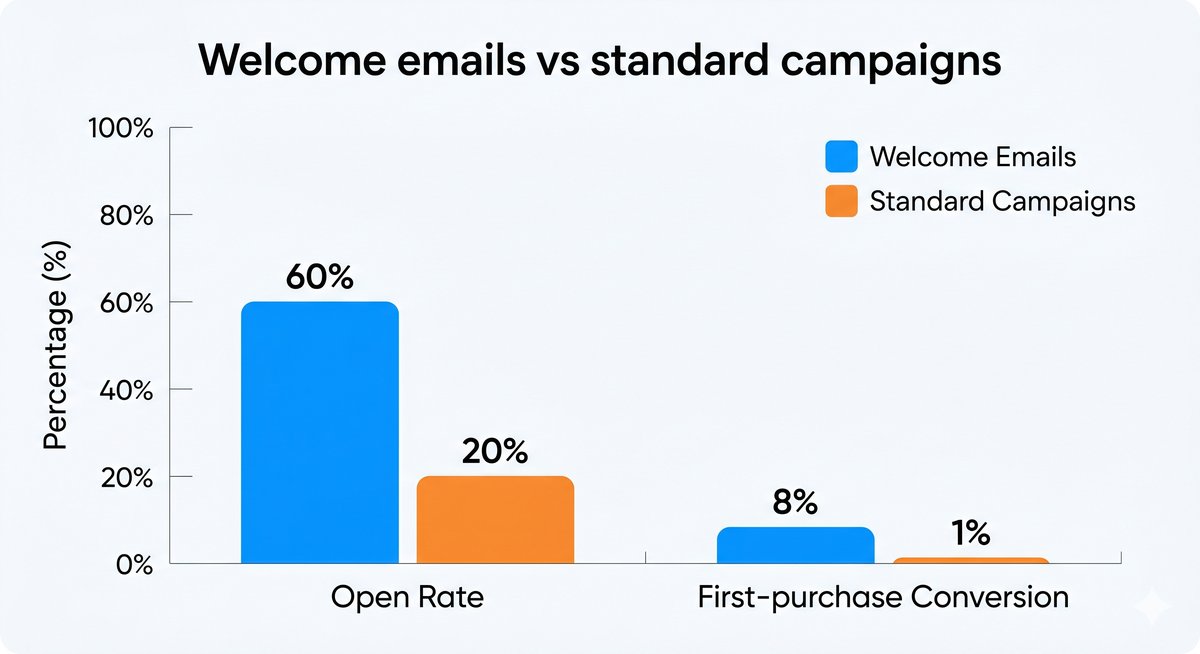
Welcome emails earn more attention than anything else you send. According to Klaviyo's ecommerce benchmark data, welcome emails generate around $2.35 in average revenue per recipient, and open rates in the 50 to 70 percent range are normal for a well-built flow. That is roughly three times a standard campaign.
The reason is timing. A welcome email lands when interest peaks: right after signup. Industry data shows automated flows drive close to 40 percent of total email revenue from only about 5 percent of total sends. The welcome series is a big slice of that, because it catches first-time buyers when they are still deciding.
There is a second reason welcome emails matter so much. Klaviyo's flow benchmarks suggest nearly half of flow-driven revenue comes from new buyers, compared to a much smaller share from regular campaigns. In plain terms, the welcome series is where most of your first orders come from. If that automation is weak, you are paying to acquire subscribers and then losing them in the most important window. Get the welcome flow right and the rest of your email program has a stronger base to build on.
What makes one convert?
A welcome email converts when it removes friction between curiosity and a first order. That means one clear offer, one button, and copy a new subscriber can read in ten seconds.
Skip the menu of choices. The weakest welcome emails ask people to follow you on five channels, read three blog posts, and shop four collections. The strongest ones say thank you, deliver the promised incentive, and point to one place to go next. Klaviyo data on welcome flows shows full sequences can lift new-subscriber conversion by around 40 percent versus a single email, so the goal is momentum, not a single perfect send.
Personalization helps too. Adding the subscriber's first name to the subject line is a small change that, according to most ecommerce email studies, lifts open rates by roughly a quarter. Shopify's own guidance on welcome emails makes the same point: greet people by name, say thank you, and set expectations for what is coming next. None of this is complicated. It just requires discipline to keep each email focused on one job instead of cramming everything into the first send.
If you want help mapping your flow, our email automations service builds these end to end.
7 welcome email examples
Here are seven patterns that consistently perform for Shopify brands. Each one solves a specific job in the welcome series.
The instant discount email
This is the workhorse. The subscriber opted in for a discount, so you deliver it in the first email, above the fold, with one button to shop. The most common incentive in ecommerce welcome emails is a 10 percent discount, and what matters most is showing the code clearly, not making it huge. Keep the subject line direct, like "Your 10% code is inside."
The brand story email
Some brands lead with story instead of a discount, especially higher-priced or mission-driven ones. This email explains why you exist in a few short lines and links to one hero product. It works because new subscribers buy from brands they understand. Sustainability and founder-story brands use this format well.
The bestseller email
When a subscriber does not know what to buy, show them what everyone else buys. This email features three or four bestsellers with strong images and a single "shop bestsellers" button. It reduces decision paralysis and is one of the easiest emails to personalize later.
The welcome series opener
Rather than one email, top stores send a series. The opener says thank you, sets expectations for what is coming, and delivers the incentive. Then later emails add the brand story, social proof, and a reminder. A typical welcome series runs 3 to 5 emails spaced over several days.
The social proof email
This email leads with reviews, user photos, or press mentions. New buyers trust other buyers more than they trust your copy. A few real quotes and a star rating can do more work than a paragraph of features. It fits well as the second or third email in the series.
The product education email
For products that need explaining, like skincare or supplements, this email teaches before it sells. It answers the top question a new customer has and links to the product that solves it. Education builds confidence, and confident shoppers convert.
The final reminder email
The last email in the series creates gentle urgency. It reminds the subscriber the welcome offer is about to expire and shows the code one more time. This email often drives a surprising share of the flow's revenue because it catches people who meant to buy and forgot.
How to build it in Klaviyo
Build your welcome series as a Klaviyo flow triggered by a signup, usually a list-join or form submission. Add a short delay between emails, set conditional splits, and let smart send time handle delivery.
Start simple. Create the flow, set the trigger to your signup form, and add your first email with the incentive. Then add a one to two day delay before each follow-up. Klaviyo lets you add conditional splits, so you can send buyers down a different path than non-buyers and stop pushing the discount once someone orders. Dynamic blocks let you swap content based on profile data. Our Klaviyo audit often finds welcome flows that send the same discount to people who already bought, which quietly burns margin.
Once the basic flow works, add a few refinements. Send the first email almost immediately, within minutes of signup, while interest is highest. Use a conditional split after the opener so anyone who has not opened gets a resend with a fresh subject line. Add a "placed order" split before the final reminder so you never nag a customer who already converted. If you run SMS, you can layer a single text into the series to catch people who ignore email. These are small steps, but they compound. A welcome flow that branches by behavior almost always outperforms a flat sequence that treats every subscriber the same.
Make sure your forms feed the flow cleanly. A strong popup and capture setup is what fills the flow in the first place, and weak forms mean a starved welcome series.
Avoid these welcome mistakes
The most common welcome email mistakes are sending only one email, burying the offer, and asking for too many actions. Each one leaves revenue on the table.
A single welcome email ignores the 40 percent conversion lift a full series can deliver. Burying the discount below three paragraphs means most people never see it. And stacking five calls to action splits attention so none of them get clicked. There is also a quieter problem: deliverability. If your first welcome email lands in spam, the whole flow fails. Authentication and list hygiene matter, which is why our deliverability service treats the welcome flow as a priority. You can see more breakdowns like this on the CartStrings blog.
Conclusion
Strong welcome email examples for Shopify are not about clever design. They are about respecting a simple moment: a new subscriber is ready to buy, and your job is to make that easy. Lead with one clear offer, write copy someone can scan in seconds, and use a 3 to 5 email series instead of a single send. Build it in Klaviyo with delays, conditional splits, and clean form data feeding the trigger. Then watch the per-recipient revenue, because the welcome flow is usually the highest-earning automation in the account.
If your welcome flow is sending one email, hiding the offer, or pushing discounts to people who already bought, it is costing you first orders. Book a call and we will map a welcome series built to convert.
Frequently Asked Questions
What goes in a welcome email?
A Shopify welcome email should include a warm greeting, a one-line brand introduction, the incentive you promised at signup, and a single clear call to action. Keep it short enough to read in about ten seconds. The goal is to move a new subscriber toward a first purchase, not to explain everything about your brand at once.
How many emails to send?
Most high-performing Shopify welcome series have 3 to 5 emails sent over several days. The first delivers the incentive, the middle emails add brand story and social proof, and the last creates gentle urgency before the offer expires. A full series can lift new-subscriber conversion by around 40 percent versus sending a single welcome email.
What discount works best?
A 10 percent discount is the most common incentive in ecommerce welcome emails, and it performs well for most Shopify stores. What matters more than the size is how clearly you show the code. Some brands skip the discount entirely and lead with brand story, which can work better for premium or mission-driven products.
How to build it in Klaviyo?
In Klaviyo, create a flow triggered by your signup form or list join, then add your first email with the incentive. Add a one to two day delay before each follow-up email, use conditional splits to stop discounting people who already bought, and turn on smart send time. Clean form data feeding the trigger is what keeps the flow filled.
Why is mine not converting?
The most common reasons are sending only one email, burying the offer too far down, or asking for too many actions at once. Deliverability is another hidden cause: if the first email lands in spam, the rest of the flow never gets seen. Check your authentication, simplify to one offer and one button, and expand to a full series.