.avif)

TL;DR: A Shopify abandoned cart email reminds shoppers who left items behind to finish buying. About 70% of carts get abandoned, but a well-built Klaviyo flow recovers 10% to 25% of them. Send three emails, start within an hour, and pair email with SMS. This guide shows the timing, structure, and triggers that turn lost carts into real revenue.
Why carts get abandoned
Roughly 70% of online shopping carts never make it to checkout. That is not a small leak. For most Shopify stores, abandoned carts are the single biggest pile of revenue sitting on the table. A good Shopify abandoned cart email guide starts here, because you cannot recover sales you do not understand.
People abandon carts for ordinary reasons. They get distracted, they hit a surprise shipping cost, they want to compare prices, or they were never ready to buy yet. The fix is not guilt. It is a timely, helpful reminder that makes finishing easy. Across the Shopify stores we manage at CartStrings, the abandoned cart flow is almost always the first automation we build, because it pays for itself faster than anything else.
It also helps to know the math behind the leak. The average recovery rate across Shopify stores sits around 10.7%, but that number hides a wide range. Strong brands recover far more, and weak setups recover almost nothing. Mobile makes the gap worse, since mobile carts abandon at roughly 78%, higher than desktop. That means a big share of your lost carts come from phones, which is exactly why fast, mobile-friendly reminders matter so much.
What is a cart email?
An abandoned cart email is an automated message sent to a shopper who added items to their cart but left without buying. It fires on its own, pulls in the exact products they left, and links them back to checkout.
These emails work because the intent is already there. The shopper picked the product. They just did not finish. That is why abandoned cart emails earn open rates around 50.5% on Klaviyo, two to three times higher than a normal marketing campaign. You are not selling a stranger. You are reminding a near-buyer.
The best abandoned cart emails do three things well. They show the product clearly, they remove the small friction that stopped the sale, and they give one clear reason to come back now. Everything else is decoration. If you want help building the rest of your automated emails, our email automations service covers the full flow library.
When to send cart emails?
Send your first abandoned cart email within one hour. Speed wins. Shoppers who get an email within an hour convert far better than those who wait a day. The intent fades fast, so the first touch should feel quick and natural.
Timing data is clear on this. Rejoiner's analysis shows the first email works best at 30 to 60 minutes after abandonment. After that, send a second email around 24 hours later and a third around 72 hours later. That three-touch window captures the buyer while interest is still warm without crossing into spam territory.
Here is a simple cadence that works for most Shopify brands:
- Email 1: 1 hour after abandonment. A plain reminder, no discount.
- Email 2: 24 hours later. Add reviews, social proof, or product benefits.
- Email 3: 72 hours later. Add light urgency or a small incentive.
The first email does the heavy lifting. It drives 50% to 60% of all recoveries in the sequence. The second adds 20% to 30%, and the third adds another 10% to 15%. So if you only have time to perfect one email, perfect the first.
How many emails to send?
Three emails is the sweet spot. A single email leaves money behind, and more than three starts to annoy people and raise spam complaints. Three gives you enough touches to recover the bulk of carts without burning your sender reputation.
The revenue gap between one email and three is huge. Klaviyo's data on abandoned cart flows showed three-email sequences produced $24.9 million in recovered sales compared to just $3.8 million from single emails. That is more than six times the return for adding two more messages. If you are running a one-email flow today, adding the second and third is the fastest revenue upgrade available.
Keep the deeper sends from feeling repetitive. Each email should bring something new: the first reminds, the second builds trust, the third adds a reason to act today. We dig into testing these messages in our email campaigns work, and the same logic applies to flows.
Cart vs checkout flow
In Klaviyo, you can trigger an abandoned cart flow two ways, and the difference matters. The default flow fires on Shopify's "Checkout Started" event. A second option fires on "Added to Cart." They catch different shoppers.
Checkout Started catches people who entered the checkout and stopped. These are high-intent buyers, so this flow usually drives the most revenue. Added to Cart catches earlier, more casual browsers who never reached checkout. They convert at a lower rate but represent a much larger pool.
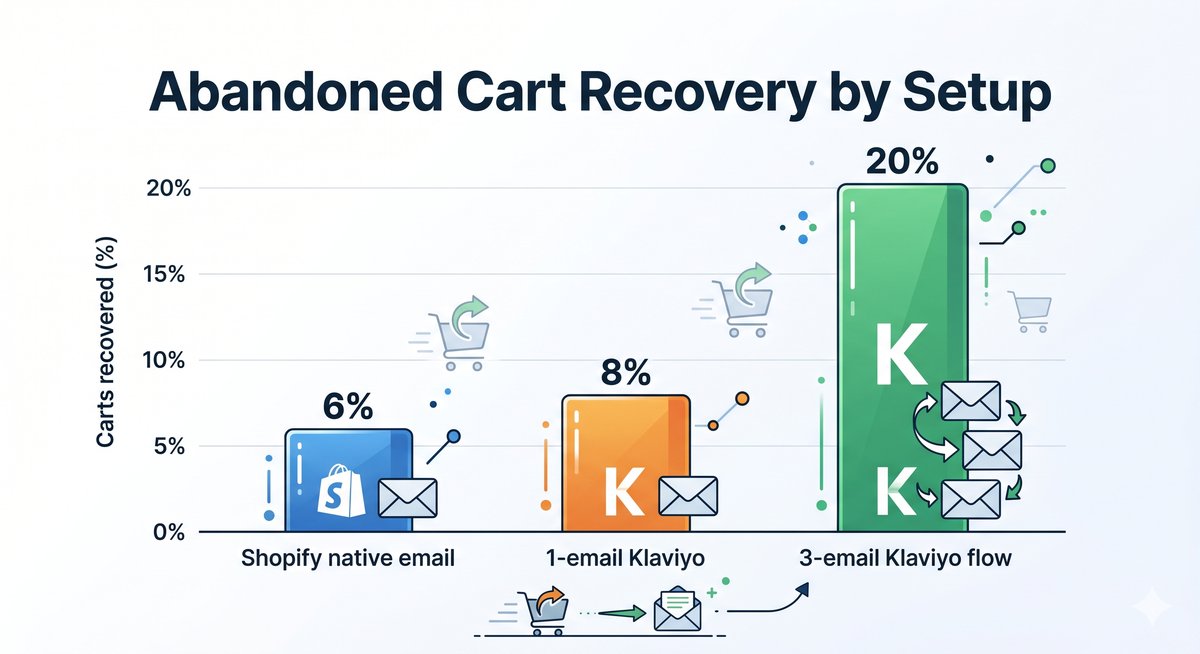
Many strong Shopify stores run both. The key is to prevent overlap. Add a filter like "Has Not Started Checkout since starting this flow" on the Added to Cart version so a single shopper does not get hit by both sequences at once. Run the checkout flow as your primary recovery engine and the add-to-cart flow as a softer top-of-funnel net. Klaviyo's sequenced approach recovers roughly 15% to 25% of carts, compared with 5% to 8% from Shopify's basic native email.
What makes emails convert?
The best abandoned cart emails feel personal, fast, and easy to act on. They show the exact product, load fast, and put one clear button front and center. The goal is to remove every reason to hesitate.
A few patterns lift conversion across almost every store we run. Lead with the product image and name, not a generic banner. Keep the subject line specific and human. Use real social proof like review counts or star ratings. And save discounts for the last email, since offering one too early trains shoppers to abandon on purpose.
Deliverability is the quiet factor here. A perfect email earns nothing if it lands in spam. Authenticate your sending domain and keep your list clean so these high-value emails reach the inbox. Our deliverability service handles the SPF, DKIM, and DMARC setup that protects flows like this. If your open rates have slipped, that is usually the first place to look.
Email and SMS together
Pairing email with SMS lifts total recovery, because the two channels reach people at different moments. A text catches someone on their phone within minutes, while the email follows with full product details and a strong call to action.
A common setup adds a conditional split that checks for SMS consent. For shoppers who opted in, send a short text around 15 minutes after abandonment, then the first email at one hour. SMS recovery alone can pull back 8% to 18% of abandoned carts, and stacking it with email captures buyers email alone would miss. Just respect consent and keep texts short, since SMS is a more personal channel than the inbox.
The order matters too. Because a text arrives faster and gets read sooner, leading with SMS for consented shoppers often recovers the sale before the email even sends. For everyone else, the email carries the full job. Build one flow that branches on consent rather than two separate flows, so your reporting stays clean and a shopper never gets double-messaged. Tested well, this combo is one of the few changes that lifts a mature abandoned cart flow without touching the copy at all.
Most stores leave SMS off the table entirely, which is exactly why it is an edge. If you collect phone numbers through your signup forms, you already have the audience. Our popup and capture work is built to grow both your email and SMS lists at the same time.
Cut your lost carts now
Abandoned carts are not a problem to accept. They are recoverable revenue waiting for a system. The pattern is proven: send three emails, start within an hour, give each message a real job, run both cart and checkout triggers, and layer SMS on top for consented shoppers. Do that, and you move from the 5% to 8% that Shopify's native email recovers toward the 15% to 25% a real Klaviyo flow delivers.
The brands that win here are not the ones with the cleverest copy. They are the ones who actually built the full sequence and kept it tuned. If your flow is missing emails, firing too late, or landing in spam, you are leaving sales behind every single day. Want a second set of eyes on yours? Start with a free Klaviyo audit or book a call and we will map the gaps.
Frequently Asked Questions
Do abandoned cart emails work?
Yes. Abandoned cart emails are one of the highest-return automations in e-commerce. They earn open rates near 50%, far above normal campaigns, because the shopper already chose the product. A well-built three-email flow in Klaviyo can recover 15% to 25% of otherwise lost carts, which is real revenue from traffic you already paid for.
When to send the first email?
Send the first abandoned cart email within one hour of abandonment. Research shows 30 to 60 minutes is the sweet spot, since shopper intent fades quickly. A fast first touch drives the majority of recoveries, so prioritize speed over a long delay.
How many emails is too many?
More than three abandoned cart emails is usually too many. Three messages recover most carts without raising spam complaints or hurting your sender reputation. A single email leaves money on the table, while four or more brings sharply diminishing returns and rising unsubscribe risk.
Should I offer a discount?
Not in the first email. Offering a discount too early teaches shoppers to abandon carts on purpose to trigger a coupon. Lead with a simple reminder and social proof, then save a small incentive for the final email if the shopper still has not converted. This protects your margins while still rescuing the sale.
Cart vs checkout: difference?
A checkout flow triggers when a shopper starts checkout and stops, signaling high intent. A cart flow triggers when someone adds an item but never reaches checkout, capturing earlier browsers. Many Shopify stores run both with a filter to avoid overlap, using the checkout flow as the primary recovery engine.