.avif)


TL;DR: A Klaviyo agency for Shopify brands builds and manages your email and SMS retention system, from flows to segmentation to deliverability. The best partners audit your account first, price between $3,000 and $15,000 a month, and aim to push email past 30% of store revenue. This guide shows what they do, what to pay, red flags to avoid, and how to vet one before you sign.
A Klaviyo agency for Shopify brands is a retention marketing partner that runs your email and SMS in Klaviyo, turning automated flows and campaigns into a measurable share of store revenue. If your Klaviyo account is sitting half-built while you chase new customers through ads, an agency exists to fix exactly that. This guide breaks down what a Klaviyo agency actually does, what it costs, the red flags that signal a bad fit, and the questions that separate a real partner from a templated vendor. Hiring the wrong one wastes months. Hiring the right one can move email from an afterthought to your most profitable channel.
What a Klaviyo agency does
A Klaviyo agency builds and runs your full retention system: flows, campaigns, segmentation, list health, and deliverability. It is not just a team that sends pretty emails on a calendar.
The work spans strategy, flow builds, copy, design, segmentation, deployment, and monthly reporting. A good agency owns the parts most Shopify brands neglect: the welcome flow, abandoned cart and checkout sequences, post-purchase, winback, and browse abandonment. These automated flows are where the money hides. Across the Shopify stores we manage at CartStrings, we typically see email drive 32% of revenue once the flow infrastructure is built right. The agency also handles the boring but critical work, like keeping your sender reputation clean so emails land in the inbox instead of spam. If you want a sense of the specialized work involved, our email automations and deliverability services map closely to what any strong partner should cover.
The other half of the job is the work you see in your inbox every week: the email campaigns. A strong agency runs a planned campaign calendar tied to your launches, promotions, and seasonal moments, then segments each send so the right customers get the right message. Nothing goes out blind. You review and approve copy and design before it ships, so the brand voice stays yours while the agency carries the workload. The reporting closes the loop each month, showing what each flow and campaign earned, where the list is growing or leaking, and what the next test should be. That feedback cycle is what separates a managed program from a pile of one-off sends.
Flows vs campaigns
Flows are automated and triggered by behavior. Campaigns are one-time sends to a list. Flows generate roughly 41% of email revenue from only about 5% of sends, so they are where an agency earns its fee.
Klaviyo's benchmark data shows flow revenue per recipient runs nearly 18 times higher than campaigns. That gap is the whole argument for hiring help. A founder can blast a newsletter. Few have time to build, test, and maintain a dozen behavior-triggered sequences that quietly print money in the background. A real agency builds or rebuilds your flow infrastructure first, then layers campaign volume on top. If a partner leads with "we'll send you four campaigns a week" and never mentions flows, you are paying for the cheap half of the work.
What it costs
Most Klaviyo agencies charge $3,000 to $15,000 per month, with setup fees often running $1,000 to $5,000. Pricing depends on scope, brand size, and whether SMS is included.
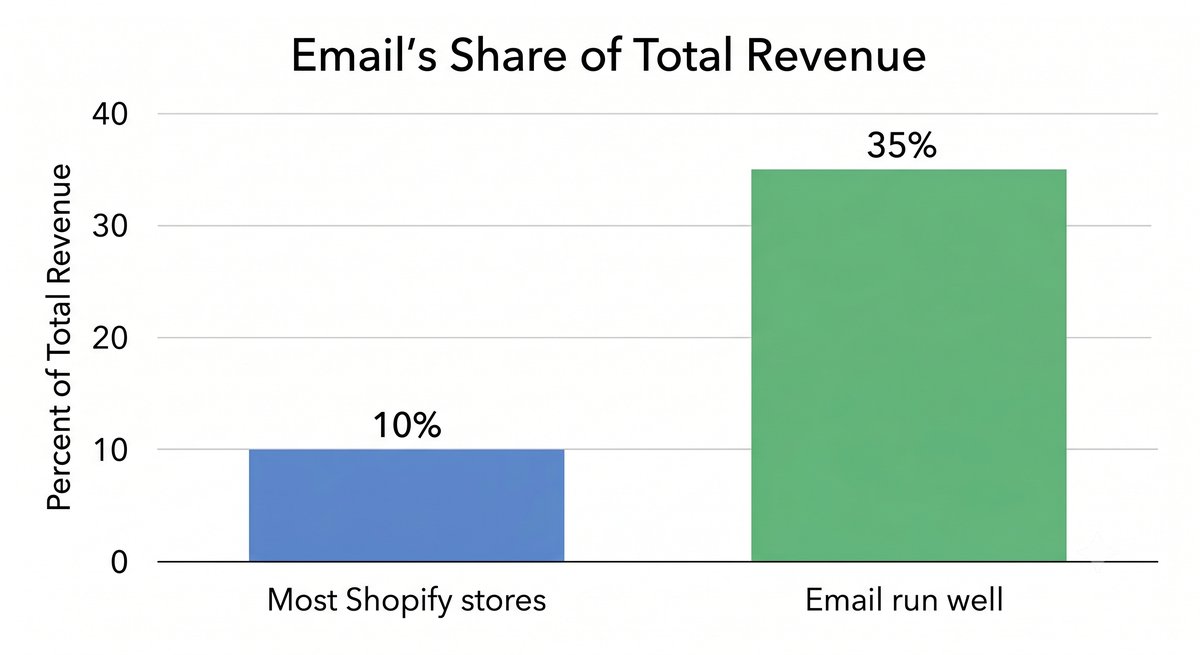
Pricing usually follows one of four models: flat monthly retainer, revenue share, hybrid, or per-project. Retainers and revenue share are the most common. An agency managing flows, campaigns, and SMS together sits at the higher end. A campaigns-only engagement sits lower. The cheapest option is rarely the best one. Low pricing often signals inexperience, offshore teams with thin ecommerce knowledge, or bare-minimum service. For most brands doing $500k or more a year, a mid-range retainer pays for itself fast when email moves from 10% to 30% of revenue. Run the math on your own numbers before you anchor on a price.
Agency vs in-house
For most Shopify brands under $10M, a Klaviyo agency is the most cost-effective path because you get a full team of skills for less than one senior hire plus benefits.
A freelancer is cheap and flexible but rarely has every skill: strategy, copy, design, and deliverability all in one person is rare. In-house makes sense once email and SMS revenue clearly justifies a full-time salary plus health insurance and PTO, which adds thousands beyond the base pay. Above $10M, many brands run a hybrid: an in-house strategic lead with agency execution support. The right answer depends on your revenue, your team, and how complex your lifecycle is. There is no universal winner, only the model that fits your stage.
Klaviyo partner tiers
Klaviyo ranks agencies in its partner program across Silver, Gold, Platinum, and Elite (Master) tiers. Higher tiers signal more experience, more clients managed, and certified teams.
Silver is the entry point. Gold partners manage a growing book of clients. Platinum partners are treated as Klaviyo experts with priority access to Klaviyo leadership. Elite, also called Master Elite, is the top status, reserved for the most proven agencies. Tier alone does not guarantee fit, but it is a useful filter. You can verify any agency's status in Klaviyo's partner directory before you talk. A partner badge plus real Shopify case studies beats a generalist marketing shop that treats Klaviyo like any other email tool.
Red flags to avoid
The biggest red flag is an agency that builds before it audits. Any partner promising specific revenue numbers before seeing your account is reverse-engineering what you want to hear, not strategizing.
Watch for templated automations, where every client gets the identical welcome series and cart flow regardless of business. Watch for no CRM or account audit before work starts. Be wary of anyone quoting a 15-day open-rate attribution window, since Apple's Mail Privacy Protection has made open rates unreliable for years, and a long open window is often used to inflate results. The cheapest quote is its own warning sign. A strong agency asks thoughtful questions about your customers and goals before proposing anything, and it can show concrete certifications and case studies on request. If you are weighing whether your current setup is even worth keeping, a structured Klaviyo audit gives you an honest baseline first.
What to expect early
A solid agency audits your account before touching anything, then rebuilds your flow infrastructure in the first weeks. Expect measurable flow revenue gains within 60 to 90 days.
The audit looks at flow performance by segment, campaign attribution over the trailing 90 days, list health, and revenue per recipient. Campaign performance shows up fast: about 30 days of consistent, well-segmented sends produces clear data. Deliverability and list-health improvements take longer, often 90 to 120 days, especially if you came in with inbox problems. Most engagements start with the core flows, like welcome, abandoned checkout, and post-purchase, before adding campaign volume. If a partner promises overnight transformation, lower your expectations. Real retention compounds over quarters, not days.
Why this matters for revenue
Done right, Klaviyo can drive 30% or more of total store revenue. Most brands hire an agency because they know that number is achievable and they are nowhere near it.
The gap is almost never the platform. It is execution: half-built flows, no segmentation, weak deliverability, and a campaign calendar with no strategy behind it. A good agency closes that gap methodically. Across the brands we manage at CartStrings, the pattern is consistent: fix the flows, clean the list, segment the sends, and email quietly becomes the highest-margin channel in the business. If you want help capturing more subscribers to feed those flows, our popups and capture work is built for exactly that. The point of an agency is not activity. It is moving email from a rounding error to a revenue engine.
Choosing the right partner
Start by shortlisting agencies with Klaviyo partner status and real Shopify case studies in your category. Then judge them on the audit, not the pitch.
Ask each one to walk you through how they would assess your account before building. Ask about a time they fixed a deliverability or automation failure. Ask which flows they would prioritize and why. The right partner answers in specifics, names trade-offs, and refuses to promise a revenue number it has not earned the right to quote. The wrong one sells you a template. Email and SMS will likely become your most profitable channel, so the agency you pick matters more than almost any other vendor decision you make. Want a second opinion on your current account? Book a call and we will tell you straight where the revenue is leaking.
Frequently Asked Questions
How much does a Klaviyo agency cost?
Most Klaviyo agencies charge between $3,000 and $15,000 per month, often with a one-time setup fee of $1,000 to $5,000. Price depends on scope, your brand size, and whether SMS management is included. Full-service agencies handling flows, campaigns, and SMS sit at the higher end, while campaign-only work costs less.
Is a Klaviyo agency worth it for a Shopify store?
For most Shopify brands doing $500k or more a year, yes. Klaviyo can drive 30% or more of total store revenue when flows, segmentation, and deliverability are done right, and most brands are far below that. The fee usually pays for itself once email moves from a small share of revenue to a major one.
How long until a Klaviyo agency shows results?
Campaign results appear fast, often within 30 days of consistent, well-segmented sends. Flow revenue gains typically show within 60 to 90 days. Deliverability and list-health improvements take longer, usually 90 to 120 days, especially if your account had inbox problems before the engagement started.
Should I hire an agency, a freelancer, or build in-house?
A freelancer is cheap but rarely has every skill. In-house makes sense once email revenue justifies a full salary plus benefits. For most brands under $10M, an agency gives you a full team for less than one senior hire. Above $10M, a hybrid of in-house lead plus agency execution often works best.
What should a Klaviyo agency do before starting work?
A good agency audits your account first. It reviews flow performance by segment, campaign attribution over the past 90 days, list health, and revenue per recipient before building anything. An agency that starts building campaigns without an audit, or promises a revenue number before seeing your data, is guessing rather than strategizing.