.avif)

TL;DR: A Klaviyo abandoned cart flow triggers on "Added to Cart" and reaches shoppers who never start checkout, while an abandoned checkout flow triggers on "Checkout Started" and reaches shoppers who entered their email but did not buy. Checkout abandoners have higher intent and a known email. Most Shopify brands should run checkout as the primary flow and cart as a soft backup, with a filter so no one gets both.
The abandoned checkout vs cart question comes down to one thing: a Klaviyo abandoned checkout flow recovers buyers who already gave you their email, while an abandoned cart flow tries to reach everyone who added a product. Both run inside Klaviyo on Shopify, both fire automatically, and both make money. But they trigger on different events, reach different shoppers, and pull in very different revenue. Pick the wrong primary flow and you leave easy sales on the table. Pick the right setup and you recover a chunk of the 75% of carts that get abandoned every year.
Most store owners use the two terms as if they mean the same thing, and that confusion costs them. The names sound interchangeable, but in Klaviyo they point to two separate metrics, two separate triggers, and two separate audiences. Getting the distinction right is the first step toward a recovery system that actually pays for itself. This guide breaks down the difference, the data, and the exact setup we use across the Shopify stores we manage.
What is abandoned cart?
An abandoned cart flow in Klaviyo fires when a shopper adds a product to their cart but never moves to checkout. It runs on the "Added to Cart" metric, a custom event Klaviyo tracks once you install a small code snippet in your Shopify theme. It does not come on automatically.
This flow casts the widest net. It can reach a browser who clicked "add to cart," looked around, and left, long before they would ever type an email. The catch: Klaviyo can only send to people it can identify, usually because they clicked an earlier email or filled out a popup. A cold, cookied visitor with no email on file cannot be emailed at all. That is why cart flows often reach fewer people than store owners expect.
The cart flow shines at one job: catching shoppers higher in the funnel who showed interest but never committed. A first-time visitor who added a product, got distracted, and bounced is a real opportunity. If they are already in your list, the cart flow can pull them back with a quick reminder. Strong email capture through a popup or signup form is what makes this flow worth running, because the more known emails you have, the more shoppers the cart flow can actually reach. Without that capture layer, even a perfect cart flow sends to almost no one.
What is abandoned checkout?
An abandoned checkout flow fires when a shopper reaches the checkout page, enters their email at the first step, and then leaves without buying. It runs on the "Checkout Started" metric (Klaviyo also calls it "Started Checkout"), which ships with the native Shopify integration. No code snippet needed.
Because the shopper typed their email into checkout, Klaviyo always has a way to reach them. That single fact makes this the higher-converting flow for most stores. The shopper got far enough to share contact info and start paying, so their buying intent is strong. They were one field away from a purchase.
This flow also tends to fire reliably out of the box. Since "Checkout Started" comes from the native Shopify connection, there is no snippet to break and no theme update that can quietly kill the trigger. For a busy store owner, that reliability matters as much as the conversion rate. A flow that always fires and always reaches a real inbox is worth more than a flow that captures more shoppers on paper but depends on a fragile setup. This is the main reason we tell new clients to get the checkout flow live and dialed in first, then build the cart flow on top of it.
Cart vs checkout: the gap
Here is the core split. "Added to Cart" fires earlier in the funnel and captures more people but at lower intent. "Checkout Started" fires later, captures fewer people, but those people are warmer and always reachable.
Think of it as two nets at two depths. The cart net catches casual shoppers near the surface. The checkout net catches serious buyers who waded in deep. The deeper net pulls fewer fish, but they are the ones worth keeping. This is why Klaviyo's own documentation steers most Shopify stores toward the checkout trigger as the workhorse flow, with cart as a supporting layer.
There is also a data difference under the hood. The checkout flow can pull live cart contents, names, and product details from the native Shopify integration, so your emails can show the exact items left behind. The cart flow can do this too once the snippet is installed, but it depends on that setup being correct. When the events fire cleanly, both flows can show dynamic product blocks that remind the shopper exactly what they wanted. Setting up these flows correctly is the kind of work our email automations service handles for clients every day.
Which flow converts more?
For most Shopify brands, the abandoned checkout flow converts more revenue per recipient. Checkout abandoners showed real intent and handed over an email, so a well-timed reminder closes a high share of them.
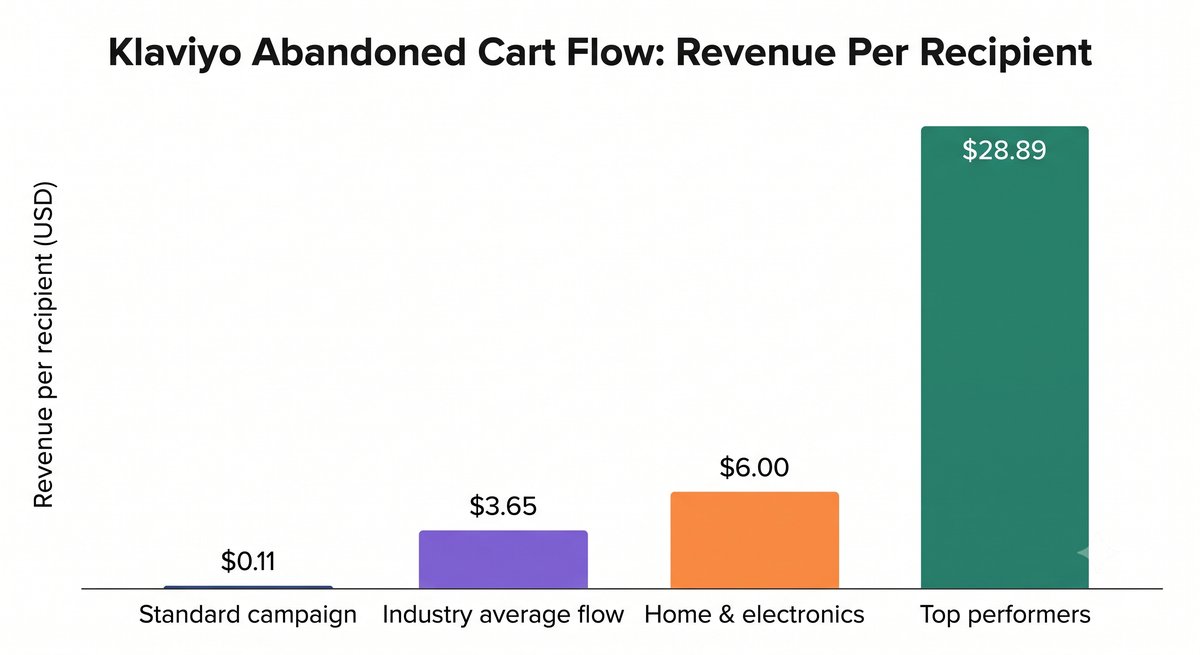
The data backs this up. Klaviyo's benchmark data shows abandoned cart and checkout flows average $3.65 in revenue per recipient, versus just $0.11 for a standard campaign. Top performers hit $28.89 per recipient, nearly eight times the average. Average open rates for these flows sit around 50%, with the top ten percent of brands reaching 65%. The recovery rate for a typical store runs 3% to 5% of abandoned carts, while leaders recover 10% to 14%.
The gap between average and top performers is the real story. It is rarely the flow type that holds a brand back; it is the execution. The same checkout flow can earn $3.65 or $28.89 per recipient depending on timing, copy, product blocks, and list health. The lower-intent cart flow still earns its place by catching shoppers the checkout flow never sees, but the checkout flow is where the bigger dollars live for almost every store. If your numbers fall short of these benchmarks, a Klaviyo audit will show you exactly where the leaks are.
Run both without overlap
The best setup is not one flow or the other. It is both, with a filter so no shopper gets double-emailed. Run "Checkout Started" as your primary flow. Run "Added to Cart" as a secondary flow that sends one soft reminder to known shoppers who never reach checkout.
The fix that makes this safe is a flow filter on the Added to Cart flow. Add two conditions joined with AND logic: "What someone has done > Started Checkout > zero times since starting this flow" and "Placed Order zero times since starting this flow." This pulls anyone out of the cart flow the moment they start checkout, so they only ever get the checkout sequence. Without it, the same shopper can receive both flows and land six emails in three days, which tanks your engagement and your deliverability. The filter is the difference between a clean funnel and a spam complaint.
When should each flow fire?
Speed wins. The first email in either flow should send within one hour of abandonment, while intent is still hot. After that, a short delay before email two and a longer gap before email three works well for both cart and checkout sequences.
Do not stop at one email. Klaviyo analysis found three-email sequences generated $24.9 million against $3.8 million from single-email flows, a 6.5x difference. The first email reminds, the second adds urgency or social proof, and the third can carry a gentle offer. For the checkout flow, you can be more direct since intent is higher. For the cart flow, keep the tone lighter; these shoppers were just browsing. You can find more flow breakdowns in our articles library.
Timing also depends on your average order value. A store selling a $40 product can move fast and lean on a small discount in the final email. A store selling a $400 product needs more patience, since a bigger purchase takes longer to decide on, so a longer window with stronger reassurance often beats a quick price cut. Test your delays against your own data rather than copying a generic template. The right cadence for your store is the one your revenue numbers confirm, not the one a blog post hands you.
Email vs SMS recovery
Email carries both flows for most stores, but SMS is a strong add-on for the checkout flow. A shopper who started checkout often shared a phone number too, and a short text sent soon after abandonment can catch them faster than email.
Use SMS sparingly and only with consent. A single, well-timed text in the checkout flow can lift recovery without annoying people. The cart flow is a worse fit for SMS, because lower-intent shoppers rarely shared a phone number and a text to a casual browser feels pushy. As a rule, lead with email on both flows, then layer one SMS message into the checkout sequence where intent is highest. Pairing email and SMS is one of the easiest ways to squeeze more revenue out of the checkout flow without writing a single new email.
Common setup mistakes
The biggest mistake is running only one flow. Stores that set up just a checkout flow miss browsers who never reach checkout, and stores that run just a cart flow miss the higher-intent buyers and earn less per send. The second mistake is running both without an exclusion filter, which double-emails shoppers and trains inboxes to mark you as spam.
Two more traps show up often. First, leaving the cart flow on the default settings without confirming the "Added to Cart" snippet is installed, so the flow technically exists but almost never fires. Second, sending a single email instead of a sequence, which leaves most of the recoverable revenue untouched. Watch your flow analytics for a sudden drop in recipients or conversions, since that usually signals a broken trigger or a missing filter. Catching these early is the difference between a flow that quietly earns and one that quietly fails.
What we see at CartStrings
Across the Shopify stores we manage at CartStrings, the checkout flow consistently out-earns the cart flow, often by a wide margin, because every recipient has a known email and proven intent. The cart flow adds incremental revenue but never replaces it.
The pattern is clear: brands that run only a cart flow, or run both without an exclusion filter, leave money on the table and risk burning their list. Brands that lead with checkout, layer a filtered cart flow underneath, and send three timed emails capture the most. Both flows together, set up right, routinely sit among the top revenue drivers in an account. If you want this dialed in without the trial and error, book a call and we will map it to your store.
Frequently Asked Questions
Is abandoned cart the same as abandoned checkout in Klaviyo?
No. Abandoned cart uses the "Added to Cart" metric and fires when someone adds a product but never starts checkout. Abandoned checkout uses the "Checkout Started" metric and fires when someone enters their email at checkout but does not buy. They trigger on different events and reach different shoppers.
Which flow should I set up first?
Set up the abandoned checkout flow first. It runs on the native Shopify integration with no code, reaches shoppers who already gave you an email, and converts more revenue per recipient. Add the cart flow second as a soft reminder for browsers who never reach checkout.
Will running both flows double-email my customers?
Only if you skip the filter. Add a flow filter to the Added to Cart flow with two AND conditions: Started Checkout zero times since starting this flow, and Placed Order zero times since starting this flow. This removes anyone who progresses to checkout, so they only get one sequence.
Why does my abandoned cart flow reach so few people?
Klaviyo can only email shoppers it can identify. A cart flow relies on the "Added to Cart" event, which often fires for cookied visitors who never shared an email. If Klaviyo has no email on file, it cannot send. The checkout flow always has an email because the shopper typed it in.
How many emails should each flow have?
At least three. Klaviyo data shows three-email sequences earn far more than single emails. Send the first within an hour, the second after a short delay, and the third with a light offer. Keep the checkout flow direct and the cart flow softer.