.avif)


TL;DR: How much does Klaviyo cost depends on your active profiles, not your total list. The free plan covers 250 profiles. Paid email plans start at $20/month and scale to roughly $2,300/month at 250,000 profiles. Adding SMS starts at $35/month. Most charges that surprise people come from non-consenting contacts getting counted and SMS credits burning faster than expected.
If you run a Shopify store and you're asking how much does Klaviyo cost, the short answer is: it scales with the number of people you can email, starting free and climbing as your list grows. A brand with 5,000 active profiles pays around $100 a month for email. One with 50,000 pays about $720. But the sticker price hides a few mechanics that catch store owners off guard, like getting billed for contacts who never opted in. This guide breaks down every Klaviyo pricing tier, how SMS credits work, the hidden add-on costs, and whether the spend actually pays off. By the end you'll know exactly what to budget.
What does Klaviyo cost per month?
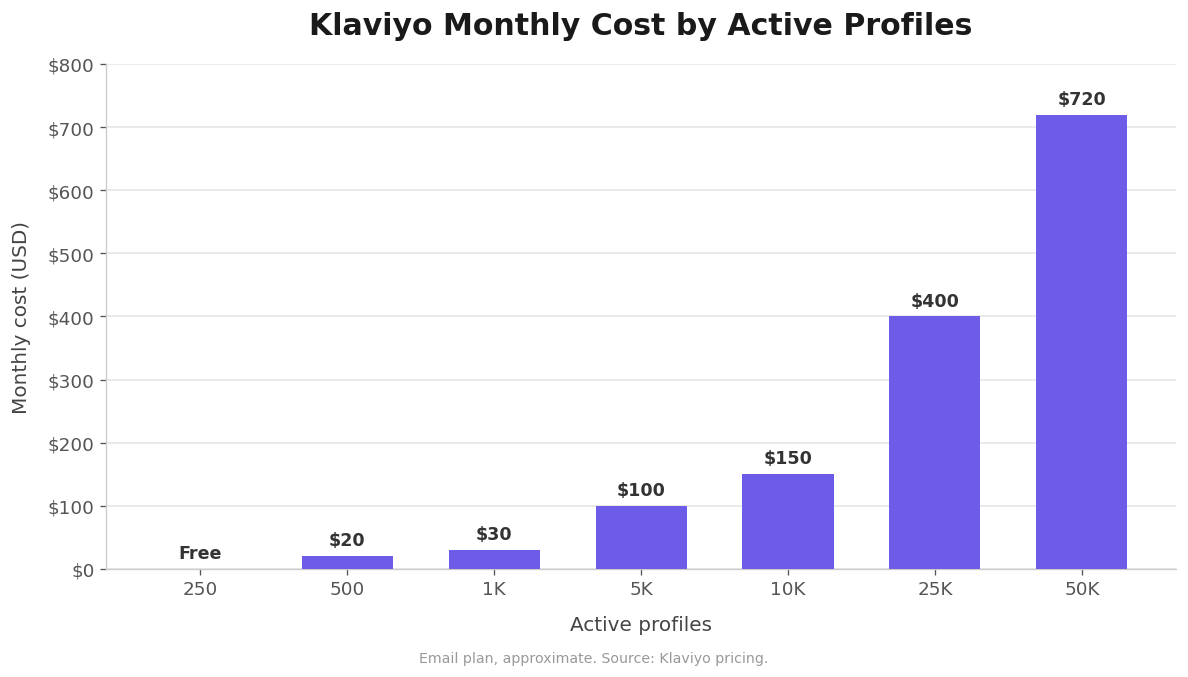
Klaviyo costs $0 to start and scales by active profiles. Email-only plans begin at $20/month for 500 profiles. A 5,000-profile store pays about $100/month, 10,000 runs near $150, and 50,000 lands around $720. Adding SMS starts at $35/month. Your exact price comes from the active-profile count on your account.
Klaviyo uses usage-based pricing tied to active profiles, so two stores with identical revenue can pay very different amounts based on list size. The platform has three core tiers: a free plan, an email plan, and a combined email plus SMS plan. The free plan gives you 250 active profiles, 500 monthly email sends, and 150 SMS credits, which is enough to test the platform but not to run a real program at $500k+ in revenue.
The paid email plan starts at $20/month for the 251 to 500 profile band. The email plus SMS plan starts at $35/month and bundles 1,250 SMS credits. From there, your price climbs in steps as your profile count crosses each threshold.
How much is Klaviyo by active-profile tier?
Klaviyo's price steps up as your active-profile count grows. At 1,000 profiles you pay around $30/month, at 10,000 about $150, at 25,000 roughly $400, and at 50,000 about $720. These are approximate. Only the official slider on Klaviyo's pricing page gives you the exact figure for your tier.
Here's a working reference table for email-plan pricing. Treat these as close estimates, not quotes, since Klaviyo adjusts tiers and the pricing slider is the only exact source.
- Up to 250 profiles: $0 (free)
- 500 profiles: $20/month
- 1,000 profiles: ~$30/month
- 1,500 profiles: $45/month
- 5,000 profiles: ~$100/month
- 10,000 profiles: ~$150/month
- 20,000 profiles: ~$375/month
- 25,000 profiles: ~$400/month
- 50,000 profiles: $720/month
- 250,000 profiles: ~$2,300/month
Notice the curve. The jump from 1,500 to 5,000 profiles roughly doubles your bill, and the climb from 25,000 to 50,000 nearly doubles it again. List growth is good for revenue, but it directly raises your software cost, which is why list hygiene matters so much. Pruning dead weight keeps you in a lower tier without hurting sales.
How does Klaviyo billing actually work?
Klaviyo bills you on active profiles, meaning any profile you're able to email, whether or not they consented. Suppressed profiles are never billed. Klaviyo changed this model on February 18, 2025, and now caps tier increases at 25% per billing cycle. The system auto-upgrades you but never auto-downgrades.
This is the part most store owners miss. Your bill is not based on your total list size or even your subscriber count. It's based on active profiles, which means anyone you have the technical ability to email, including contacts who never clicked an opt-in box. Suppressed profiles (unsubscribed, bounced, or manually suppressed) don't count toward your bill.
The February 2025 billing change added a guardrail: your tier can't jump more than 25% in a single billing cycle, which softens the blow of a sudden list spike. But the system only moves in one direction automatically. It auto-upgrades when you cross a threshold and never auto-downgrades, so if you clean your list you have to manually drop your plan.
Why did my Klaviyo bill go up?
Your bill usually rises because integrations quietly add billable profiles. Shopify checkout, Meta lead ads, and quiz tools push non-consenting contacts into Klaviyo, and each one counts as active. A 90-day re-suppression lock also means once you unsuppress someone, you pay for them across about three cycles before you can suppress them again.
This is the trap. Your Shopify checkout, Meta lead ads, and quiz integrations silently create profiles for people who bought once or abandoned a cart without ever subscribing. Those profiles are emailable, so they're billable, even if you'd never send them a marketing email.
Then there's the re-suppression lock. Once you unsuppress a profile, Klaviyo won't let you suppress it again for 90 days. So a careless bulk unsuppress can push you into a higher tier and hold you there across roughly three billing cycles. The fix is disciplined list management: regularly suppress profiles who haven't engaged in 90 to 120 days, and audit which integrations are adding contacts. If your bill jumped and you're not sure why, a Klaviyo audit will trace exactly where the extra profiles came from.
How much does Klaviyo SMS cost?
Klaviyo SMS runs on credits. One credit equals one 160-character SMS segment, and in the US a credit costs roughly $0.0092 to $0.0120 depending on volume. A US MMS uses 3 credits, a UK text uses 5, and international rates vary. Credits reset monthly with no rollover, so unused credits are lost.
The SMS credit system is where budgets slip. A single text message isn't always one credit. Messages over 160 characters split into multiple segments, and each segment is a separate credit. Worse, adding an emoji or certain special characters switches the message encoding, which cuts the per-segment character limit and can triple your credit use on a message you thought was short.
Carrier fees are bundled into the credit price, so there's no separate line item to track. But the no-rollover rule means you should size your credit bundle to your actual monthly send volume, not your peak month. If you buy big for Black Friday, those credits don't carry into December. Keep messages tight, plain-text where possible, and under 160 characters to stretch every credit.
What are the hidden Klaviyo costs?
Beyond the base plan, Klaviyo sells add-ons that raise your total cost: Reviews at $25/month, Marketing Analytics at $100/month, and a Customer Data Platform at $500/month. Brands spending over $10,000/month can move to Klaviyo One, which adds a 20% surcharge on top.
The base subscription is rarely the final number. Klaviyo's add-on products stack on top of your profile-based plan. Reviews runs $25/month, Marketing Analytics adds $100/month, and the full CDP is $500/month. For enterprise-scale brands, Klaviyo One bundles everything but tacks a 20% surcharge onto spend above $10,000/month.
For most $500k to $5M Shopify brands, the email or email plus SMS plan covers what you need, and the add-ons are optional. The point is to budget for total cost of ownership, not just the line item you see when you sign up. A store at 25,000 profiles paying $400 for email might really be spending $525 once Reviews and Marketing Analytics are on. Building a high-converting program also depends on capturing the right contacts up front, which is where strong popups and capture forms earn their place.
Is Klaviyo worth it for Shopify brands?
Klaviyo is worth it when email drives a meaningful share of revenue, which it does for most Shopify brands. Email typically accounts for around 27% of store revenue, and mature programs push past 33%. With e-commerce email returning roughly $36 to $45 per $1 spent, the software cost is small against what it generates.
The math favors Klaviyo for any store running real campaigns and flows. Email drives about 27% of e-commerce store revenue on average, and well-run programs reach 33.7%. Across the Shopify stores we manage at CartStrings, we typically see email-attributed revenue around 32%, which lines up with where a focused program lands.
Flows do the heavy lifting. Automated flows generate roughly 41% of email revenue from only about 5.3% of sends, because they hit people at the exact moment they're ready to buy. Abandoned-cart flows earn around $3.07 in revenue per recipient, and welcome flows about $2.35. Set those up well and your Klaviyo bill pays for itself many times over. If your flows aren't built or aren't converting, that's the gap to close first, and our email automations service exists to do exactly that.
How does Klaviyo compare to competitors on price?
Klaviyo is not the cheapest tool, but it's the most capable for Shopify. Mailchimp Standard starts near $20/month but lost native Shopify sync in 2019. Omnisend runs about 50% cheaper at 50,000 contacts, around $400 to $500 versus Klaviyo's $720, and bundles email plus SMS. Shopify Email is cheapest but thin on features.
Price isn't the whole story. Mailchimp's Standard plan looks comparable at the low end, but its native Shopify integration ended in 2019, so syncing now means third-party connectors and lost data fidelity. Omnisend undercuts Klaviyo at scale, running roughly half the price at 50,000 contacts while bundling SMS, which makes it a real option for cost-sensitive brands. Shopify's own email tool is the cheapest path but lacks the segmentation, flow logic, and reporting depth that drive serious revenue.
For most $500k+ Shopify brands, Klaviyo's deeper Shopify integration, segmentation, and flow capabilities justify the premium. The right question isn't which tool is cheapest, it's which tool returns the most per dollar. When email is a third of your revenue, capability beats a slightly lower invoice.
What to budget and what to do next
Budget by your active-profile count, add SMS if you text, and factor in any add-ons you actually need. A typical $1M Shopify brand with 20,000 to 30,000 profiles should plan for $375 to $525/month all-in. Then make that spend earn its keep by keeping your list clean, your flows live, and your deliverability high.
The cost of Klaviyo is rarely the problem. The problem is paying for the platform and only using a fraction of it. If your active-profile count is creeping up, your SMS credits are vanishing, or your email campaigns aren't pulling their weight, the fastest fix is a clear-eyed look at your account. If you'd like help finding where revenue is leaking before you pay another invoice, book a call with CartStrings and we'll walk through it with you.
Frequently Asked Questions
How much does Klaviyo cost per month?
Klaviyo starts free for up to 250 active profiles. Paid email plans begin at $20/month for 500 profiles and scale with list size, reaching about $100/month at 5,000 profiles and $720/month at 50,000. Adding SMS starts at $35/month. Use the official pricing slider for your exact number.
Is Klaviyo free?
Yes, Klaviyo has a free plan that covers 250 active profiles, 500 monthly email sends, and 150 SMS credits. It's good for testing the platform but too limited for a store doing real volume. Once you cross 250 profiles or need more sends, you move to a paid plan starting at $20/month.
Why did my Klaviyo bill go up?
Your bill rose because your active-profile count crossed a tier threshold. This often happens when integrations like Shopify checkout, Meta lead ads, or quizzes add non-consenting contacts that count as billable. A 90-day re-suppression lock can also keep unsuppressed profiles on your bill for about three cycles.
What are active profiles in Klaviyo?
Active profiles are any contacts you have the technical ability to email, regardless of whether they consented to marketing. Klaviyo bills you on this count, not your total list or subscriber count. Suppressed profiles, like unsubscribes and hard bounces, are never billed.
How much does Klaviyo SMS cost?
Klaviyo SMS uses credits, where one credit equals one 160-character segment. In the US a credit costs about $0.0092 to $0.0120 depending on volume, a US MMS is 3 credits, and a UK text is 5. Credits reset monthly with no rollover, and emojis can multiply your credit use.