.avif)

TL;DR: Email marketing for Shopify is how stores turn customer data into automated, repeatable revenue. The best setup pairs Klaviyo with a handful of core flows, regular campaigns, and clean deliverability. Done right, email drives 30% or more of total store revenue at an ROI of roughly $36 to $42 for every $1 spent. This guide covers the platform choice, the flows, list building, segmentation, and the metrics that matter.
Email marketing for Shopify is the practice of using owned channels like email and SMS to turn store data into automated revenue that the brand controls outright. For a Shopify store, email is the highest-ROI channel you have, returning $36 to $42 for every $1 spent based on widely cited industry data. Paid ads rent attention. Email owns it. In this guide you'll learn which platform to use, the exact flows to build first, how to grow your list, and how to read the numbers that actually predict revenue. The goal is simple: get email marketing for Shopify generating a real share of your sales, not just sending the occasional newsletter.
Why email beats other channels
Email is the only channel where you own the audience. You don't rent it from a platform that can change its algorithm or raise ad costs overnight. For Shopify brands, that ownership translates into the best return in marketing. Industry data puts email ROI between $36 and $42 for every dollar spent.
The reason is data. Every action a shopper takes on your store, viewing a product, adding to cart, buying, becomes a trigger you can act on. Across the Shopify stores we manage at CartStrings, email typically drives around 32% of total revenue once flows and campaigns are dialed in. That share doesn't come from blasting your whole list. It comes from sending the right message to the right person at the right moment.
Klaviyo vs Shopify Email
What is the best email platform for Shopify? For most stores past the starting line, it's Klaviyo. Shopify Email is free up to 10,000 sends a month and lives inside your admin, which makes it fine for simple newsletters when you're small. But its automation and segmentation are limited.
Klaviyo is built around the behavioral data Shopify generates. It's free up to 250 active profiles, then runs about $45 a month at 1,000 profiles. The rule of thumb: stay on Shopify Email while you're under roughly $5k a month, then move to Klaviyo around $10k a month, when advanced flows and segmentation start earning far more than the subscription costs. If you're unsure where you stand, a Klaviyo audit will show whether your current setup is leaving money on the table.
The core automated flows
What emails should a Shopify store send? Automated flows come first. Flows are triggered emails that run 24/7 without you touching them. Klaviyo's benchmark data shows flows generate about 18 times more revenue per recipient than one-off campaigns, from roughly 5% of total send volume. That is the single biggest lever in email marketing for Shopify.
Build these flows in order of impact. The abandoned cart flow recovers shoppers who added to cart but didn't buy. It posts the highest revenue per recipient of any flow, around $3.65 on average. The welcome flow greets new subscribers and converts them while interest is high. Welcome emails see open rates above 80%. After those, add browse abandonment, post-purchase, winback for lapsed buyers, and replenishment for consumable products. Setting up and maintaining these is the heart of our email automations work.
One detail matters: use sequences, not single emails. Klaviyo's data shows three-email abandoned cart sequences produced 6.5 times more revenue than single-email versions. More touches, more recovered sales.
When to send campaigns
Flows run on autopilot. Campaigns are the broadcasts you send to a segment on a schedule, product launches, sales, restocks, and content. Mature email programs earn 40% to 50% of email revenue from campaigns and the rest from flows. You need both.
The mistake stores make is sending every campaign to their entire list. That hurts deliverability and trains inboxes to ignore you. Send to engaged segments instead. Our email campaigns approach leans on segmentation so each send reaches people likely to open and buy, which protects your sender reputation.
How to grow your list
You can't email people who never signed up. List growth starts with a popup. Klaviyo recommends a popup submit rate of 3% or higher as a healthy target. Well-built popups can lift signups meaningfully.
A few rules. Ask for email only in the first step. Adding an SMS field too early lowers conversion. Multi-step forms tend to outperform single-step ones. Delay the popup 10 to 50 seconds so it doesn't interrupt the first impression, and add an exit-intent version to catch leaving visitors. Offer a real incentive like a discount or free shipping. Getting popups and capture right feeds every flow downstream, because a bigger, cleaner list means more welcome-flow revenue.
Segment for relevance
Why does segmentation matter? Because relevance drives revenue. Sending the same email to everyone wastes your best customers and annoys your least engaged ones. Segmentation splits your list by behavior so each message fits the reader.
Start with a few segments that earn their keep. Engaged subscribers, those who opened or clicked recently, should get your campaigns. VIPs, your repeat buyers, deserve early access and special offers. New subscribers belong in the welcome flow. Lapsed buyers go into winback. When form data flows into Klaviyo profiles, you can personalize content and product recommendations down to the individual. This is also how you protect deliverability, since you stop emailing people who never engage.
Keep emails out of spam
How do you keep Shopify emails out of spam? Deliverability is the quiet foundation under everything above. If your emails land in spam, none of your flows matter. As of February 2024, Google's sender guidelines and Yahoo's matching rules require bulk senders to authenticate with SPF and DKIM, align DMARC, keep spam complaints under 0.3%, and offer one-click unsubscribe.
Practically, that means setting up a dedicated sending domain and verifying SPF, DKIM, and DMARC all pass. It means cleaning your list so you stop mailing dead addresses, which is exactly why a sunset flow and engaged-only sending matter. Enforcement has only tightened since 2024, with non-compliant mail now facing rejection. If your open rates are sliding, deliverability is the first place to look. Our deliverability work exists to keep inbox placement high so your revenue numbers hold.
What the numbers should say
How much revenue should email generate for a Shopify store? Top ecommerce brands pull 30% to 40% of total revenue from email and SMS combined. If you're well below that, the gap is usually flows, segmentation, or deliverability, not effort.
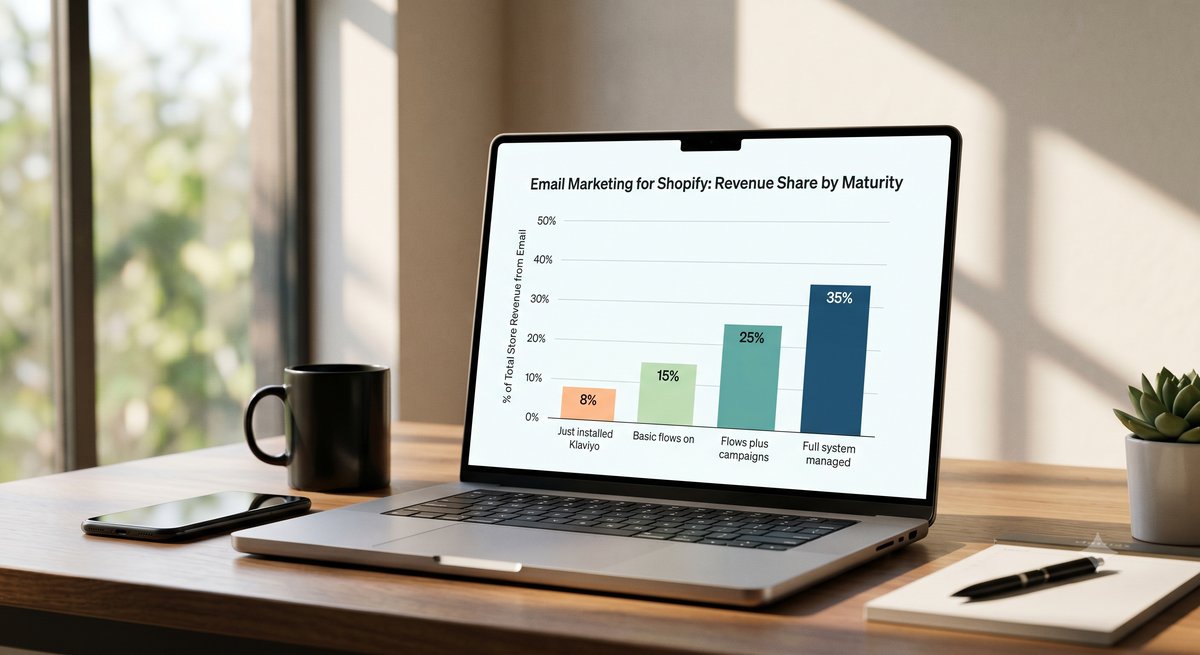
Track the right metrics. Make revenue per recipient your primary number for campaigns and flows, since it ties directly to money. Use click rate as your engagement proxy. Treat open rate as directional only, because Apple Mail Privacy Protection inflates it. A store generating 8% of revenue from email and one generating 35% are usually running the same tools, the difference is how well the flows, segments, and sender reputation work together.
Do it yourself or hire out
Here's the part most guides skip. Installing Klaviyo and turning on the default flows gets you maybe a third of the way to that 30% revenue number. The other two-thirds comes from work that compounds over months: rewriting flow copy that converts, building segments that actually move, watching deliverability so a Gmail update doesn't quietly tank your sends, and running campaigns on a calendar instead of when you remember to. That's a real job, not a weekend project.
So how do you decide? A useful test: add up the hours you spend on email each month and multiply by what your time is worth. If that number is climbing past what specialized help would cost, and your email share of revenue is stuck in the teens, you've outgrown the DIY phase. The math usually flips somewhere between $30k and $50k a month in store revenue. Below that, learning it yourself is fine and often smart. Above it, every month you run a half-built program is revenue you're leaving on the table. There's no shame in either choice, but it should be a choice, not a default you backed into because nobody had time to look.
The honest version of this decision isn't "Klaviyo or no Klaviyo." It's "who owns the system once it's live." Email is the rare channel that keeps paying after the setup is done, but only if someone keeps it healthy. Decide who that someone is before your open rates make the decision for you.
Conclusion
Email marketing for Shopify isn't about sending more email. It's about building a system: the right platform, a core set of flows, smart campaigns to engaged segments, a list that grows on autopilot, and clean deliverability holding it all up. Each piece compounds the others. Installing Klaviyo is the start, not the finish. The stores hitting 30% of revenue from email got there by treating it as an owned revenue channel and tending it like one. If you'd rather hand the whole system to a team that does this every day, book a call and we'll map out where your store is leaving revenue behind. You can also browse more guides in our articles library.
Frequently Asked Questions
Is email worth it for Shopify?
Yes. Email is the highest-ROI channel available to Shopify stores, returning roughly $36 to $42 for every $1 spent based on industry data. Unlike paid ads, you own the audience, so the channel keeps working without rising ad costs. For most stores, email and SMS together drive 30% or more of total revenue once the core flows and campaigns are running.
Klaviyo or Shopify Email?
Shopify Email is fine while you're small, under roughly $5k a month, because it's free up to 10,000 sends and built into your admin. Once you pass about $10k a month, Klaviyo's advanced flows, segmentation, and analytics typically earn far more than the subscription costs. Most growing Shopify brands move to Klaviyo to unlock real automation.
How much does Klaviyo cost?
Klaviyo is free up to 250 active profiles. After that it bills on active profiles, roughly $20 a month at 500 profiles and about $45 a month at 1,000. SMS is billed separately. Because pricing scales with your list, list hygiene directly affects your bill, another reason to remove unengaged subscribers regularly.
Which flows come first?
Start with the abandoned cart flow and the welcome flow, since they produce the highest revenue per recipient. Then add browse abandonment, post-purchase, winback, and replenishment if you sell consumables. Build each as a multi-email sequence rather than a single send, because sequences recover far more revenue.
What % should email drive?
Top Shopify and ecommerce brands generate 30% to 40% of total revenue from email and SMS combined. If your store is well under that, the cause is usually missing flows, weak segmentation, or deliverability problems rather than how often you send. Closing that gap is where most stores find their fastest revenue win.