.avif)

Spray and pray email marketing used to be the default for e-commerce. Build a list, write one email, blast it to everyone, and hope enough people buy to make the numbers work. For Shopify stores still running this playbook, the math has turned ugly. Segmented email campaigns generate 760% more revenue than non-segmented ones, according to Campaign Monitor. That gap isn't closing. It's widening every quarter as inbox providers get stricter and customers get pickier about what earns their attention.
This isn't a philosophical argument about "better marketing." It's a practical one. The tools to send targeted, behavior-driven emails already exist inside your Klaviyo account. The brands using them are pulling 25-35% of total revenue from email. The brands still blasting their full list are watching open rates erode, spam complaints tick up, and revenue flatline. Here's why the old approach is failing and exactly what to replace it with.
What "Spray and Pray" Actually Costs You
The obvious cost of batch-and-blast email is low engagement. When you send the same promotional email to your entire list, you're showing hiking boots to someone who only buys running shoes. That person ignores the email. Do it enough times, and they stop opening anything you send.
But the hidden costs are worse. Every ignored email tells Gmail, Yahoo, and Outlook that your messages aren't wanted. These inbox providers track engagement signals like opens, clicks, and replies. When those signals drop, your sender reputation drops with it. Eventually, even your best emails start landing in spam folders or promotions tabs, where they collect dust instead of revenue.
The numbers back this up. Gmail now requires bulk senders to maintain spam complaint rates below 0.3%, and ideally under 0.1%. As of November 2025, Google shifted from soft warnings to active rejection of non-compliant emails at the SMTP level. That means your emails don't just get filtered to spam. They bounce entirely. Microsoft, Yahoo, and Apple have all implemented similar enforcement. Together, these four providers serve roughly 90% of consumer and business email users globally.
For a Shopify store doing $1M+ in annual revenue, even a small dip in deliverability can mean tens of thousands in lost email-attributed sales. Spray and pray doesn't just underperform. It actively undermines your ability to reach the people who want to hear from you.
Why Customers Tune Out Generic Emails
The average person receives around 121 emails per day. That's not a typo. Your promotional email is competing with dozens of other brands, plus work emails, personal messages, and newsletters. In that environment, relevance is the only currency that matters.
Research from McKinsey found that 71% of consumers expect personalized interactions from brands, and 76% get frustrated when it doesn't happen. For e-commerce, this translates directly to behavior. A customer who bought a moisturizer two weeks ago doesn't want an email about moisturizers. They want a follow-up asking how they like it, paired with a recommendation for the serum that complements it. A first-time visitor who browsed winter jackets but didn't buy wants a nudge with the specific jacket they viewed, not a generic "New Arrivals" blast.
Personalized emails deliver 6x higher transaction rates than generic ones. That multiplier exists because targeted emails answer a question the customer is already asking: "Is this relevant to me?" When the answer is yes, they click. When it's not, they scroll past, or worse, hit the unsubscribe button. Each unsubscribe isn't just one lost contact. It's lost future revenue from someone who was interested enough to opt in originally.
The Deliverability Trap Most Stores Don't See Coming
Here's where spray and pray gets genuinely dangerous. Every email you send contributes data to your sender reputation. When a large chunk of your list consistently ignores your emails (doesn't open, doesn't click, never buys), inbox providers interpret that as a signal that your emails aren't wanted.
Gmail's filtering system now uses AI that goes beyond simple spam keywords. It analyzes engagement patterns, sending consistency, authentication compliance, and recipient behavior. Emails that generate replies and clicks get prioritized. Emails that get ignored or deleted without opening get deprioritized. Over time, this creates a feedback loop: your emails perform worse because fewer people see them, and fewer people see them because your emails perform worse.
The 2024 sender requirements made this even more concrete. Bulk senders (anyone sending over 5,000 messages daily to Gmail addresses) must now have proper SPF, DKIM, and DMARC authentication. They must include one-click unsubscribe. And they must stay below that 0.3% spam complaint threshold. If you're blasting your full list with untargeted content, you're far more likely to trip these thresholds than a store sending targeted messages to engaged segments.
Across the Shopify stores we manage at CartStrings, we consistently see that brands with proper segmentation and engagement-based sending maintain inbox placement rates above 99%. The stores still running batch-and-blast? They're the ones asking why their open rates dropped from 25% to 12% over six months.
How to Build a Behavior-Based Email Program in Klaviyo
Moving away from spray and pray doesn't mean sending fewer emails. It means sending the right emails to the right people based on what they've actually done. Klaviyo makes this straightforward because it syncs directly with your Shopify store data in real time, tracking browsing behavior, purchase history, cart activity, and engagement signals.
Start With Your Core Automated Flows
Flows are the backbone of any revenue-driving email program. Unlike campaigns (one-time sends), flows trigger automatically based on customer behavior. They run 24/7 and, when set up correctly, they generate revenue on autopilot.
Every Shopify store running Klaviyo should have these flows active at minimum:
Welcome Series. Triggers when someone joins your list. This is your highest open-rate flow (often 40-60%) and sets the tone for the entire relationship. A strong welcome series introduces your brand story, highlights bestsellers, and includes a first-purchase incentive. Across well-optimized accounts, welcome flows typically convert at 3-5%.
Abandoned Cart. Triggers when someone adds to cart but doesn't check out. Abandoned cart emails see 40-45% open rates and around 3.3% conversion rates, making them the single highest-performing automated flow for most stores. The first email should fire within 4 hours of abandonment. Include the specific products left behind, not generic messaging.
Browse Abandonment. Triggers when someone views a product but doesn't add to cart. This captures earlier-stage intent. The key is showing the exact products they browsed, paired with social proof like reviews or ratings.
Post-Purchase. Triggers after a customer completes an order. This flow builds loyalty and drives repeat purchases. Use conditional splits in Klaviyo to branch the experience: first-time buyers get a brand education sequence, repeat buyers get a loyalty acknowledgment and cross-sell recommendations based on what they just purchased.
Win-Back. Triggers when a customer hasn't purchased in a set period (typically 60-90 days, depending on your product's repurchase cycle). This flow re-engages lapsed customers before they churn entirely.
These five flows alone can account for 15-25% of a store's total revenue when properly built and optimized. The critical detail: every one of these flows sends different content to different people based on their behavior. That's the opposite of spray and pray.
Segment Your Campaigns by Engagement and Behavior
Flows handle the automated, behavior-triggered side. But most stores also send regular campaigns (promotional emails, new product launches, sales announcements). This is where segmentation makes the biggest difference.
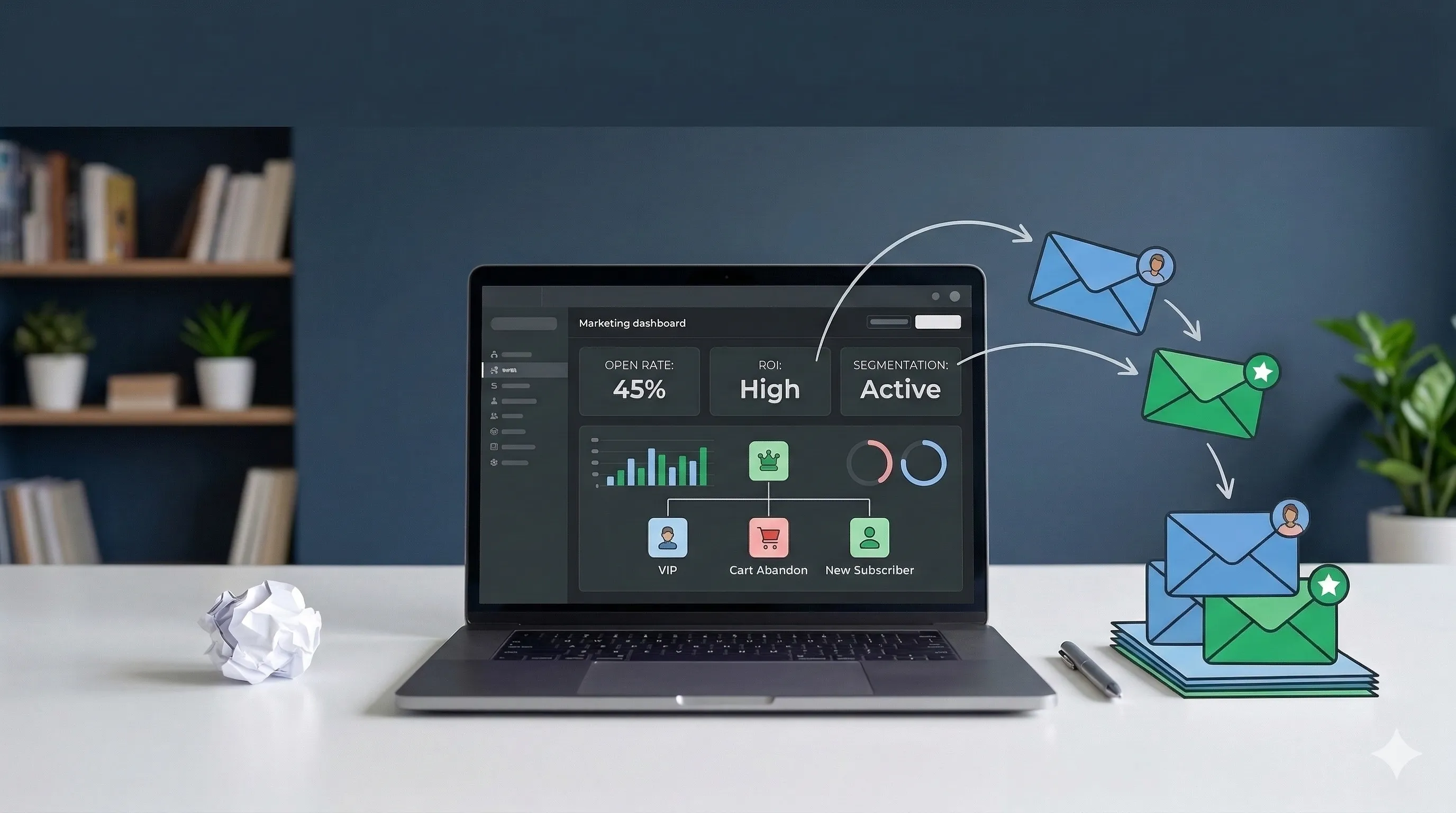
Instead of sending every campaign to your full list, build segments in Klaviyo based on engagement level and purchase behavior. Here are the segments that matter most:
Engaged subscribers. People who have opened or clicked an email in the last 30-60 days. This should be your primary campaign audience. Sending to engaged subscribers keeps your open rates high, your spam complaints low, and your sender reputation strong.
Active buyers. Customers who have purchased in the last 90 days. These people already trust your brand. They're receptive to new product announcements, cross-sells, and loyalty offers.
VIPs. Your top 10-20% of customers by total spend or order frequency. This segment deserves exclusive treatment: early access to sales, special bundles, loyalty perks. In Klaviyo, you can use the predicted customer lifetime value (CLV) metric to identify these customers automatically.
At-risk customers. People who used to be active but haven't engaged or purchased recently. Klaviyo's predictive analytics can flag profiles with high churn probability, letting you target them with a re-engagement campaign before they disappear entirely.
New subscribers who haven't purchased. These contacts need education and trust-building, not hard sales. Send them content-driven emails, customer stories, and low-friction offers.
The simple act of splitting your list into engaged vs. unengaged and sending campaigns only to the engaged segment will improve your open rates, click rates, and revenue per email almost immediately. It will also protect your deliverability by keeping spam complaints far below that 0.3% threshold.
Using Klaviyo's Predictive Analytics to Send Smarter
One of the most underused features in Klaviyo is its predictive analytics engine. For stores with enough purchase history (at least 500 customers with three or more orders), Klaviyo automatically calculates several forward-looking metrics for every customer profile.
Predicted CLV estimates how much a customer will spend in the next 12 months. Use this to identify your future VIPs and invest in retaining them early.
Expected date of next order tells you when a customer is likely to purchase again based on their historical buying pattern. Build a flow that triggers a few days before this date with a personalized recommendation or a replenishment reminder.
Churn risk probability flags customers who are likely to stop buying. Target high-churn-risk, high-value customers with a special offer or a personal outreach before they lapse.
These predictions update automatically as new data comes in, so your segments stay current without manual work. The result is a system where your emails reach people at the moment they're most likely to act, based on data rather than guesswork.
Klaviyo's Segments AI feature makes building these audiences even faster. Instead of manually configuring filters, you can describe the segment you want in plain language ("customers likely to purchase again in the next 30 days who haven't received an email in 2 weeks") and the AI builds the logic for you.
The Practical Shift: What to Do This Week
If you're reading this and realizing your email program still leans heavily on full-list blasts, here's a concrete starting point.
Day 1-2: Audit your sending. Look at your last 10 campaigns in Klaviyo. How many went to your full list vs. a targeted segment? Check your open rates, click rates, and unsubscribe rates. If open rates are below 30% and unsubscribes are climbing, you have a spray-and-pray problem.
Day 3-4: Build your engagement segments. Create a "30-day engaged" segment (opened or clicked in the last 30 days) and a "90-day engaged" segment. Start sending your next campaign only to the 30-day engaged group and compare the results.
Day 5-7: Review your core flows. Make sure you have at least a welcome series, abandoned cart, and post-purchase flow live. If they exist but haven't been updated in months, check that the content is current and the timing is optimized. If you're not sure where your flows stand, a Klaviyo audit can identify exactly what's leaking revenue and where to focus first.
Ongoing: Stop blasting your full list. This is the single most impactful change you can make. Every campaign should go to a defined segment. Even your biggest sale of the year should be sent in waves: engaged subscribers first, then a broader group if results warrant it.
The Bottom Line
Spray and pray email marketing was never a strategy. It was a workaround for not having the data or tools to do better. Shopify stores running Klaviyo don't have that excuse. The data is already there, syncing in real time from your store. The segmentation tools are built in. The predictive analytics are running in the background. The only thing missing is the decision to use them.
The brands that treat email as a targeted, behavior-driven channel are generating 25-35% of their total revenue from it. The brands still blasting their full list are leaving most of that on the table while slowly eroding their ability to reach anyone at all. The gap between these two approaches gets wider every month. The good time to make the switch was a year ago. The next best time is now.