.avif)
ChatGPT Just Killed Its Shopping Checkout (and Why That Makes Your Email List More Valuable Than Ever)

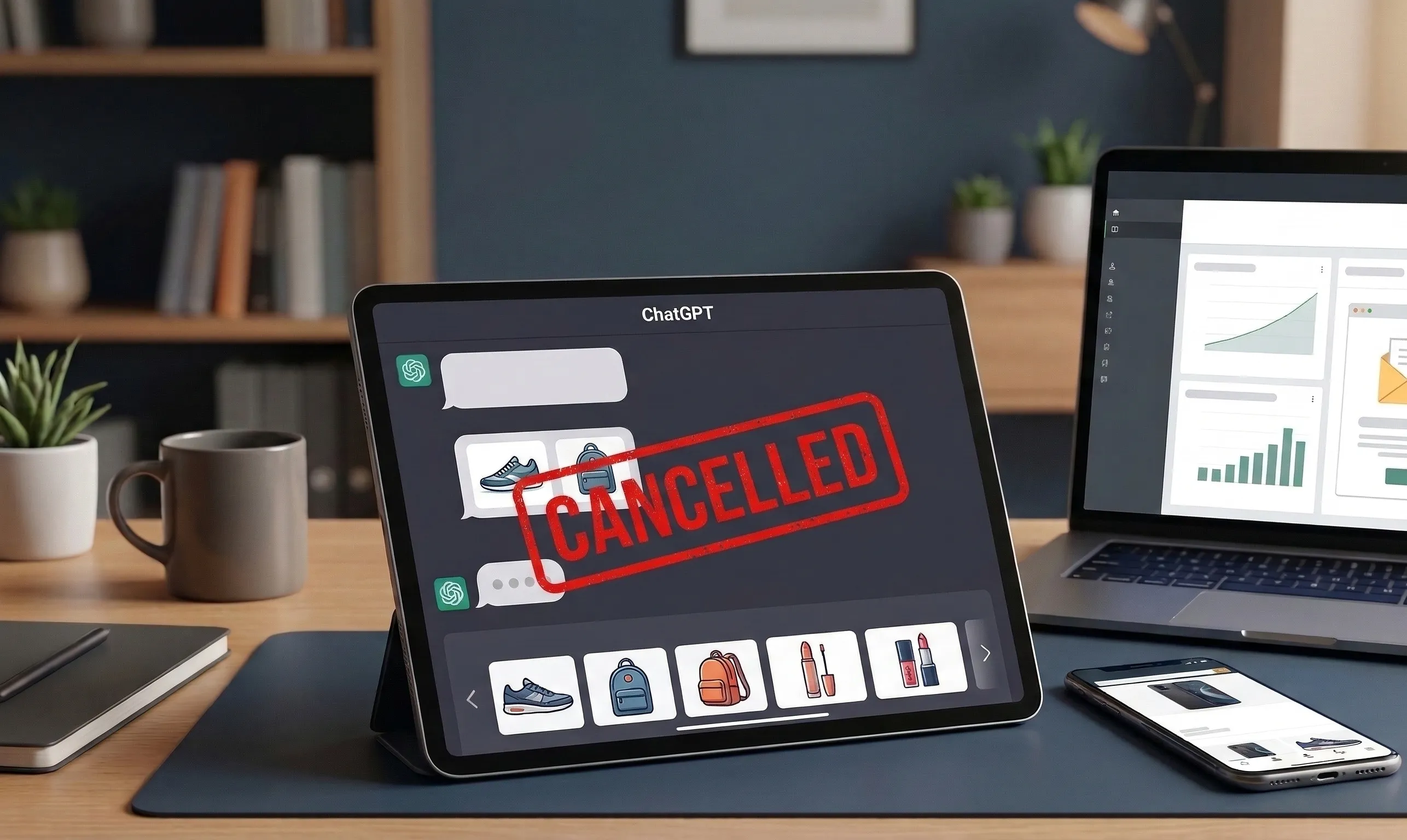
OpenAI spent fourteen months trying to turn ChatGPT into a shopping mall. Partnerships with Walmart, Target, Shopify, Etsy, and PayPal. A native checkout feature called "Instant Checkout." A whole new protocol built with Stripe to process transactions inside the chat window. The vision was bold: 700 million weekly users discovering and buying products without ever leaving the conversation.
Then, in March 2026, OpenAI pulled the plug on direct checkout. The reason was painfully simple. People browsed, compared, and researched products inside ChatGPT. They just didn't buy there. For Shopify brands investing in email marketing vs AI shopping, this is a case study worth paying attention to.
What Actually Happened with ChatGPT Shopping
The timeline tells the story. In April 2025, OpenAI launched an ad-free shopping experience inside ChatGPT. Users could search for products, see recommendations with images and reviews, and click through to retailer websites. It was positioned as a direct challenge to Google Shopping, minus the ads.
By September 2025, OpenAI went further with "Instant Checkout," a feature that let users complete purchases without leaving ChatGPT. The company partnered with Shopify to bring millions of merchant listings into the platform. Etsy joined and even agreed to cover OpenAI's commission fees to help get things moving.
The results were dismal. Out of the millions of merchants on Shopify's platform, roughly a dozen actually integrated with ChatGPT's checkout. Shopify president Harley Finkelstein confirmed this at an investor conference in early 2026. Users were happy to ask ChatGPT for product recommendations, but when it came time to enter a credit card number, they opened Amazon or went directly to the brand's website instead.
By December 2025, things got worse. OpenAI's experimental "app suggestions" for brands like Target and Peloton started appearing in unrelated conversations, and users revolted. People asking about Windows encryption were seeing prompts to shop for groceries. OpenAI's chief research officer admitted publicly that the company "fell short" and disabled the feature within days.
In March 2026, OpenAI officially abandoned native checkout. An OpenAI spokesperson confirmed the shift, stating they are "evolving the commerce strategy within ChatGPT to better meet merchants and users where they are." Translation: the checkout is moving back to the retailer's own website or app.
Google Already Proved This Doesn't Work
If this sounds familiar, it should. Google tried the exact same thing and failed the exact same way.
Starting in 2002 with Froogle (yes, that was the real name), Google spent over two decades trying to become a place where people buy things, not just search for them. The most direct attempt was "Buy on Google," launched in 2018, which let shoppers add products to a cart and check out without leaving Google's ecosystem.
Google actively recruited sellers, attended e-commerce conferences, and even dropped commission fees to zero in 2020 to attract merchants. By the end of that year, they had about 8,000 sellers on the platform. But conversion rates stayed low, user trust never materialized, and Google shut down Buy on Google in September 2023.
The conclusion from Marketplace Pulse at the time summed it up perfectly: Google has zero market share of e-commerce because it never figured out how to be a retailer. But it became the biggest advertising network for e-commerce, so its impact on online shopping is enormous. Shopping passes through Google. It doesn't happen on Google.
OpenAI is now learning the same lesson, and arriving at the same destination. After abandoning checkout, the company launched ads inside ChatGPT in February 2026, charging roughly $60 per thousand impressions with a $200,000 minimum commitment for advertisers. The pivot from "we'll process your transactions" to "we'll sell ads against your attention" mirrors Google's playbook almost exactly.
Why Shoppers Won't Buy Inside AI Chatbots
The pattern here isn't random. There are structural reasons why checkout inside a search or AI platform keeps failing.
Habits are deeply embedded. People know how to buy on Amazon. They trust their saved payment methods on Shopify stores they've purchased from before. They have loyalty points, delivery preferences, and return processes they understand. Asking someone to complete a transaction inside a chatbot means asking them to abandon years of muscle memory for zero obvious benefit.
Trust is earned at the point of purchase. Consumers separate "research mode" from "buying mode." A chatbot is great for comparing running shoes or narrowing down a moisturizer. But the moment money changes hands, people want to be on a site they recognize, with a checkout flow they've used before, backed by customer service they can find if something goes wrong.
The operational complexity is massive. Real-time inventory syncing across millions of products, sales tax collection across thousands of jurisdictions, fraud prevention, refund handling. OpenAI hadn't even built a sales tax collection system as of February 2026. These are problems that Amazon and Shopify have spent decades solving, and they're not trivial for a company whose core product is a language model.
Analysts at TD Cowen called OpenAI's retreat a "stunning admission," noting that the idea of AI platforms replacing apps to become the new operating system for commerce "is either not playing out, or at a minimum is pushed back significantly."
What This Means for Shopify Brands
Here's where this gets practical for e-commerce brands, especially those doing $500K or more annually on Shopify.
The discovery layer for products is fragmenting fast. Consumers are increasingly starting product research on ChatGPT, Perplexity, and Google's AI Overviews instead of traditional search. Adobe Analytics found that traffic from generative AI tools to retail sites grew 693% year-over-year during the 2025 holiday season. That's real and accelerating.
But discovery is not conversion. And the platforms handling discovery are proving, repeatedly, that they cannot handle the transaction. Google tried and failed. OpenAI tried and failed. The transaction keeps flowing back to the places customers already trust: your Shopify store, Amazon, and the brand's own checkout experience.
This creates a specific strategic reality. The top of the funnel is getting noisier and less controllable. You can't predict which AI platform will send you traffic next month, or whether that platform will even exist in its current form a year from now. What you can control is what happens after someone lands on your site.
That's your email list. That's your automations. That's your owned channel.
Why Your Email List Is the Asset That Actually Compounds
Every shift in the discovery landscape makes owned channels more valuable, not less. Here's why email specifically stands out for Shopify brands right now.
Email doesn't depend on algorithms you can't control. Zero-click searches now account for 69% of Google queries, according to Similarweb's 2025 data. Organic click-through rates drop 61% when AI Overviews appear. Your SEO traffic is being eaten. Your paid acquisition costs keep climbing. But when you send an email to your list through Klaviyo, that message goes directly to someone who already raised their hand and said they want to hear from you.
Email converts at rates other channels can't touch. Email marketing delivers a 2.8% conversion rate for B2C brands, according to FirstPageSage. For context, the average e-commerce site converts under 2% from all traffic sources combined. And that's before you factor in the difference between a cold visitor from ChatGPT and a warm subscriber who's opened your last five emails.
First-party data is becoming the only data that matters. With third-party cookies dying, privacy regulations tightening, and AI platforms mediating more of the customer journey, the brands with direct relationships win. Your Klaviyo segments, your purchase history data, your engagement scoring: that's proprietary intelligence no AI platform can take from you.
Across the Shopify stores we manage at CartStrings, email consistently drives 25-35% of total revenue for brands with well-built automation and campaign programs. That's not a rounding error. That's a third of the business running through a channel with near-zero marginal cost.
The Practical Playbook: What to Do Right Now
Given everything happening with AI shopping and discovery, here are the specific moves Shopify brands should be making in their email programs.
Double Down on List Growth
If AI platforms are going to send you high-intent traffic that doesn't convert on the first visit (which is exactly what the ChatGPT data shows), your job is to capture that visitor's email before they leave. A well-designed popup that offers genuine value, whether that's a discount, a guide, or early access, turns a one-time AI referral into a long-term owned relationship.
The math is straightforward. If ChatGPT sends you 1,000 visitors who browse but don't buy (sound familiar?), and your popup captures 8% of them, that's 80 new email subscribers. Run those subscribers through a welcome flow, and you'll convert 5-15% of them over the next 30 days. That's 4-12 sales from traffic that would have otherwise bounced and never come back.
Build Flows That Convert Research into Revenue
AI-referred visitors tend to arrive with more context. They've already compared products, read reviews, and narrowed their options before they hit your site. They're further along in the buying process than a typical Google Shopping click.
Your Klaviyo flows should reflect that. A browse abandonment flow for someone who viewed a specific product page and left should hit differently than a generic welcome series. Include the exact product they viewed, relevant social proof, and a clear reason to come back. Set the first email to fire within an hour of the browse event while the research is still fresh.
Treat Campaigns as Your Stable Revenue Floor
When your traffic sources are unpredictable, your email campaigns become the consistent revenue baseline you can plan around. A well-segmented campaign calendar that sends 3-4 targeted broadcasts per week to engaged subscribers creates a predictable monthly revenue number that doesn't fluctuate based on which AI platform changed its shopping strategy this week.
The key word there is "segmented." Sending the same email to your entire list is a 2019 strategy. In Klaviyo, build segments based on purchase history, engagement recency, browse behavior, and predicted customer lifetime value. Send your best content to your most engaged subscribers, re-engagement campaigns to lapsing customers, and acquisition-focused messages to recent subscribers who haven't purchased yet.
Protect Your Deliverability
None of this matters if your emails land in spam. With Gmail, Yahoo, and Microsoft enforcing stricter authentication requirements for bulk senders, deliverability has become a genuine competitive advantage. Brands that maintain proper SPF, DKIM, and DMARC authentication, keep complaint rates below 0.1%, and regularly clean inactive subscribers from their lists will reach the inbox. Brands that don't will slowly disappear from their customers' inboxes without even realizing it.
The Bigger Picture
The pattern playing out right now is remarkably clear. Tech platforms are excellent at aggregating attention and terrible at converting it into transactions. Google learned this over twenty years. OpenAI is learning it in two. Both ended up in the same place: selling ads instead of processing orders.
For Shopify brands, the takeaway isn't that AI doesn't matter. It does. AI-driven discovery is reshaping how customers find products, and brands need to be visible in these new channels. But visibility without conversion is just brand awareness, and brand awareness without an owned channel to capture and nurture those customers is a leaky bucket.
Your email list is the bucket that doesn't leak. Every subscriber represents a direct line to a potential customer that no platform change, algorithm update, or failed checkout experiment can take away.
If you're not sure whether your current email program is capturing the full value of your traffic, a Klaviyo audit can show you exactly where revenue is slipping through the cracks, and what it would take to fix it.
Explore other Latest Blogs & Insights


Let’s build email marketing that feels like it was done in-house.